How much should I feed my dog? Start with the dog, not the bag
The feeding guide on the packet is a starting estimate for an average dog that does not exist. The measurement that matters is the animal in front of you — here is how to read it, and how to correct a portion that is wrong.
There is no correct number of grams that applies to a dog of a given weight. Two dogs the same size, the same age and the same breed can need portions that differ by a third, because their activity, their metabolism and whether they have been neutered all move the requirement. This is why every honest answer to this question starts in the same place: feed a sensible starting amount, then let the dog tell you whether it was right.
Why the bag over-feeds most dogs
The feeding guide on the packet is not wrong so much as generic. It is calculated for an unneutered adult of a stated weight at moderate activity, and it is usually printed as a range with the household reading the top of it. Most pet dogs are less active than that model, and neutering lowers energy requirements noticeably — so the packet figure lands high for a large share of the dogs it is fed to.
Treat it as an opening bid. Start at or slightly below the lower end of the range for your dog's ideal weight rather than its current weight, and then adjust by what you see over the following weeks.
The measurement that matters: body condition
Vets score dogs on a body condition scale rather than by weight alone, because weight without shape tells you very little. You can do the same assessment at home with your hands, and it takes about fifteen seconds.
Ribs. Run your fingertips flat along the side of the chest with light pressure. You should feel each rib easily, with a thin covering over it — the texture of the back of your own hand. If you have to press to find ribs at all, the dog is carrying too much. If the ribs are sharp and visible from across the room, too little.
Waist. Look down at the standing dog from above. There should be a visible narrowing behind the ribs. A straight line from chest to hips, or a widening, means excess weight.
Tuck. Look at the dog from the side. The belly should rise from the bottom of the ribcage towards the hind legs rather than running level.
Do this once a fortnight, not once a year. Weight gain in a dog is invisible day to day and obvious in a photograph taken six months apart, which is why it so often goes unnoticed until a vet mentions it.
Weigh the food; do not scoop it
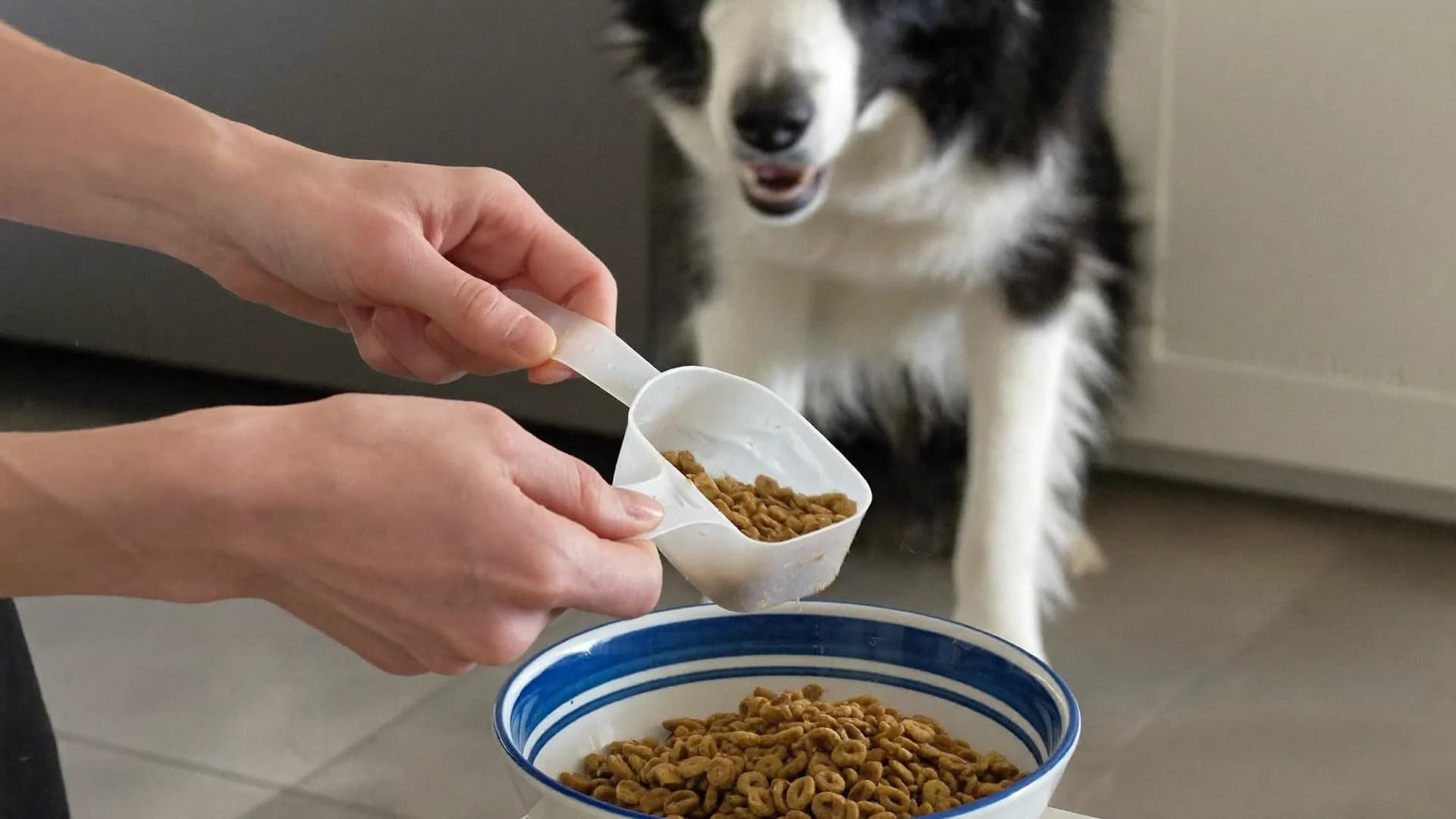
A scoop is not a unit. The same cup of the same kibble varies substantially between fillings depending on how it settles, and a household that eyeballs portions is usually drifting upwards rather than downwards. Kitchen scales cost very little and remove the entire problem, and they also make it possible to change a portion by a real ten per cent instead of by a guess.
If more than one person feeds the dog, agree the amount in grams and write it on the bin. A dog fed twice because nobody said so is the most common overfeeding accident in a busy house.
Treats are food, and they add up faster than anyone expects
The portion you have carefully weighed is only part of what the dog eats. Training treats, chews, the end of a sandwich and what falls off a high chair all count, and the usual guidance is that treats should stay a small minority of daily intake with the rest coming from a complete food. If you are training intensively, take the treat allowance out of the meal rather than adding it on top — see how many treats is too many for the arithmetic.
How to correct a portion that is wrong
Change food quantity slowly and one variable at a time. If the dog is heavier than it should be, cut the daily amount by around ten per cent, hold it there for a month, and reassess by body condition rather than by the scales alone. Ten per cent is small enough not to leave the dog hungry and large enough to move the needle over weeks.
Weight loss in dogs should be gradual. A crash reduction is unkind, it costs muscle as well as fat, and in cats it is genuinely dangerous. If a dog needs to lose a significant amount, that is a conversation with a vet rather than a project to run alone — partly because a sudden change in weight or appetite can itself be a symptom rather than a diet problem.
What changes the number
Age. Puppies of large breeds are their own subject, because growing too fast is a joint problem rather than a benefit — see feeding a large breed puppy. Older dogs generally need fewer calories and often benefit from a different formulation, covered in feeding senior pets.
Neutering. Energy requirements drop after neutering, and portions frequently do not. This is one of the most reliable causes of a dog gaining weight in its second year.
Season and workload. A dog that walks two hours a day in summer and forty minutes in winter is not the same dog nutritionally. Adjust for the winter rather than discovering it in spring.
The food itself. Calorie density varies enormously between products, so grams of one food are not grams of another. Every switch is a recalculation, not a substitution — and the switch itself should be gradual, as changing a pet's food explains.
How much should I feed my dog per day?
Start from the packet guideline for your dog's ideal weight, at or slightly below the lower end of the range, then adjust by body condition over the following weeks. There is no universal grams-per-kilo answer, because activity, age and neutering all move the requirement substantially.
How do I know if my dog is overweight?
Use your hands rather than the scales. You should feel the ribs easily under a thin covering, see a waist behind the ribs when looking down from above, and see the belly rise towards the hind legs from the side. If you have to press to find ribs, the dog is carrying too much.
Should I feed my dog once or twice a day?
Twice a day suits most adult dogs and splits the daily amount into portions that are easier on the stomach; puppies need more frequent meals. What matters more than the number of meals is that the total for the day is right and that everyone in the house knows what it is.
Is the feeding guide on the bag accurate?
It is a starting estimate, calculated for an unneutered adult at moderate activity, and it lands high for a lot of pet dogs. Use it as an opening figure for your dog's ideal weight and then correct by what you can feel on the ribs.
How fast should a dog lose weight?
Slowly. Cut the daily amount by around ten per cent, hold for a month and reassess by body condition. Rapid loss costs muscle as well as fat, and a dog needing to lose a lot should be doing it with a vet rather than alone.
Do treats count towards my dog's daily food?
Yes, and they add up faster than people expect. Treats should stay a small minority of daily intake, and during heavy training the treat allowance should come out of the meal rather than on top of it.
Why did my dog gain weight after being neutered?
Neutering lowers energy requirements, and portions usually stay where they were. It is one of the most predictable causes of weight gain in a dog's second year, and it is corrected by adjusting the amount rather than by changing food.