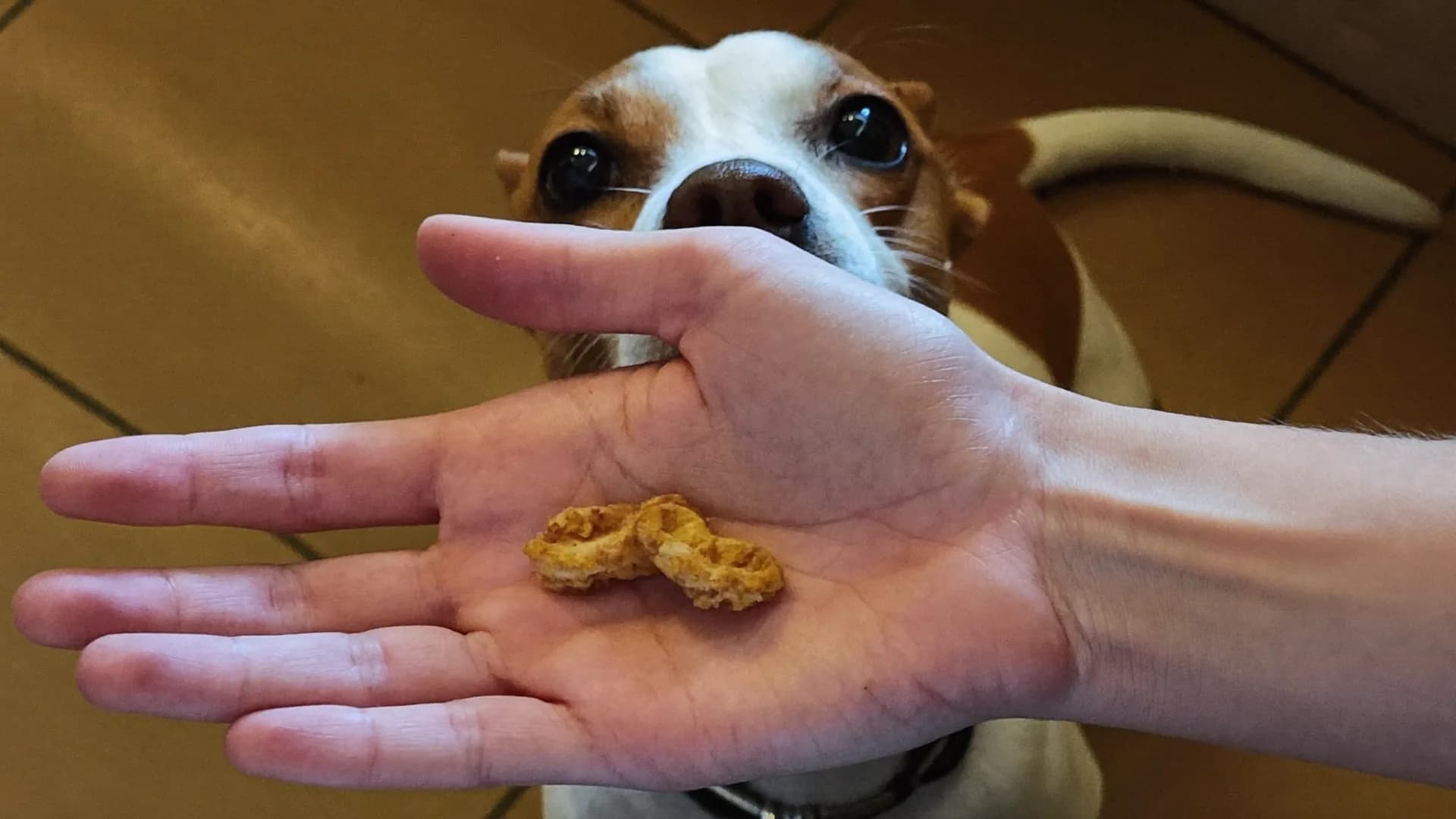
How many treats are too many? The ten-percent rule
A simple ceiling vets keep coming back to: treats should be no more than about a tenth of what a dog or cat eats in a day. The other ninety percent is where the nutrition actually lives.
Treats are how most of us talk to our animals, so the question isn't whether to give them but how many stop being a good idea.
There's a rough answer vets reach for, and it's easy to hold in your head.
The ten-percent idea
The guideline is that treats should make up no more than about a tenth of a pet's daily calories.
Under that line, treats are a small extra on top of a balanced diet. Over it, they start to crowd out the food that's actually formulated to keep the animal healthy, and the calories they add are the ones that quietly turn into weight.
The reason it's stated as a share and not a number is that a tenth of a great dane's day is a substantial handful, and a tenth of a chihuahua's is close to nothing. That's the part people underestimate: a small dog's whole daily allowance can be a single dental stick, and a cat's can be a couple of small biscuits. Size is the whole of the difference.
Why the other ninety percent is the point
A complete food is balanced on purpose — the protein, the minerals, the vitamins are all set against each other to add up to a whole diet.
Most treats aren't; they're made to be liked, not to be balanced. A few are harmless, but once they become a real share of the day, the careful balance of the main food is diluted by something that was never meant to carry it.
There's a second effect that shows up before any weight does. A pet filling up on treats eats less of its actual food, which looks to the owner like fussiness and gets answered with something tastier — and by that route a perfectly good diet is abandoned in favour of a series of snacks. The animal isn't being difficult; it's doing the arithmetic correctly.
Where the calories actually hide
Most owners who go over the line do it without recognising anything as a treat.
Dental chews are food. A daily one can be a meaningful share of a small dog's day, and they're rarely counted because they're filed under health. The same goes for a long-lasting chew, a stuffed rubber toy filled with cheese, and the peanut butter on the lick mat that keeps the dog quiet during a bath.
Training treats are food, and a good class or a solid week of recall practice is a lot of them. So are the scraps: the crusts, the last of the yoghurt, the bit of cheese handed over while cooking. And the food a cat eats at the neighbour's house is entirely invisible, which is worth bearing in mind for a cat that's gaining weight on a diet that looks correct on paper.
The commonest failure of all is a household rather than a person. Four people each giving one small thing a day is four times what any of them thinks the dog is getting, and everyone is certain it's the others.
Counting without doing sums
You don't need a calculator.
Break treats into smaller pieces — a dog values the moment more than the size. Use part of the daily food ration as training rewards, so the treats come out of the meal rather than being added to it. And keep an honest tally on the days when everyone in the house is slipping the dog something, because that's where the tenth quietly becomes a third.
A jar on the counter settles the household problem better than any amount of nagging. Measure the day's allowance into it in the morning, and when it's empty, it's empty — nobody has to remember what anyone else gave, and the dog can work the room all it likes without the total moving.
If you do want the number, the packet gives it. Divide the daily calories on the food bag by ten, then look at what the treat packet says per piece. People are routinely startled by the result, which is most of the value of doing it once.
Treats that aren't food at all
It's worth remembering what the treat is actually for, because a great deal of the time it's a way of saying something rather than a thing to eat.
For most dogs, a genuinely enthusiastic bit of praise, a few seconds of a tug toy, a thrown ball, or being let off the lead at the right moment are all rewards, and none of them costs a calorie. A dog that likes sniffing finds being allowed to stop and sniff a real reward, which is an easy one to hand out on every walk.
Cats are similar, though the currency differs. A minute with a wand toy usually beats a biscuit, and for a cat that's being kept lean, play is the treat that also burns something. For both species, a share of the day's ration scattered for the animal to find turns ordinary food into an event without adding anything at all.
None of this means never giving a treat. It means that the affection the treat is standing in for can be delivered several other ways, which is what makes staying under the line bearable rather than mean.
Choosing a treat worth the tenth
Since the allowance is small, it's worth spending it on something that earns its place.
Read the packet the way you'd read a food label: the first few ingredients tell you most of it, and a treat that's largely cereal and sugar is using up the tenth without giving anything back. Single-ingredient treats — a piece of dried meat or fish, a slice of carrot — are easy to portion and easy to understand. Anything sold as semi-moist and chewy is usually the sweetest thing in the aisle.
Human foods work well for the ones that are safe, and they have the advantage that you already know what's in them. Carrot, cucumber and green beans are near-free calorically and popular with a surprising number of dogs; a little plain cooked chicken is the highest-value training reward most dogs will ever meet. What matters is knowing which human foods are off the list entirely, since several are genuinely dangerous rather than merely fattening.
And match the treat to the job. Training wants something small, soft and swallowed instantly, so the dog is ready for the next repetition; a biscuit that takes thirty seconds to crunch ruins the rhythm. Keeping a dog occupied wants the opposite — something that takes work. Using the right one for each halves the quantity you get through.
The exceptions, and who decides them
This is general guidance rather than a prescription: an overweight pet, a medical diet or a very small animal can all change the maths, and your vet is the one to set the real number for yours.
Two cases matter in particular. A pet on a prescription diet for a kidney, urinary, liver or allergy problem can have the whole point of the diet undone by the wrong treat, so ask which ones are compatible before assuming any are. And a pet on a weight-loss plan usually needs the treat allowance carved out of its measured food rather than added, since the plan is calculated on a total.
Otherwise, the useful check is the animal rather than the arithmetic. If you can feel the ribs easily under a thin layer and see a waist from above, the total is working. If you can't, the treats are the easiest place to find the difference.
What is the ten-percent rule for treats?
Treats should make up no more than about ten percent of a pet's daily calories, so the balanced main food still does the nutritional work. Above that, the diet gets diluted and the extra calories add up.
How much is ten percent in practice?
Far less than most people expect for a small animal — a single dental stick can be close to a small dog's whole allowance, and a cat's is a couple of biscuits. Divide the daily calories on the food bag by ten and compare it with the treat packet once; it's usually a surprise.
Do dental chews count as treats?
Yes, and they're the ones most often missed because they're filed under health rather than food. So are stuffed toys, lick mats, long-lasting chews and training treats. All of it comes out of the same tenth.
Can I use my dog's normal food as treats?
Yes, and it's one of the neatest ways to stay under the line — set aside part of the daily ration and hand it out as rewards, so the treats come out of the meal instead of adding to it.
How do I stop the whole household over-treating the dog?
Measure the day's allowance into a jar on the counter in the morning, and when it's empty it's empty. Nobody has to remember what anyone else gave, and the dog can work the room without the total moving — which is the usual way four small treats a day become twelve.
What can I give instead of food?
Praise that's genuinely enthusiastic, a few seconds of tug, a thrown ball, being let off the lead, or simply being allowed to stop and sniff. For cats, a minute with a wand toy usually beats a biscuit. Scattering part of the normal ration to be found turns food into an event without adding any.
What makes a good treat?
Something you can read the ingredients of — single-ingredient dried meat or fish, or a slice of carrot or cucumber, which cost almost nothing calorically. Match it to the job too: training wants something small and swallowed instantly, while keeping a dog occupied wants something that takes work.
Do the same limits apply to cats?
The same principle holds: treats are an extra on top of a balanced diet, not a part of it. Cats are small, so a little goes a long way, and it's easy to pass the tenth without noticing — especially if the cat also eats at a neighbour's.
What if my pet is on a prescription diet?
Ask the vet which treats are compatible before giving any, because the wrong one can undo the point of a kidney, urinary, liver or allergy diet entirely. On a weight-loss plan, the treat allowance normally comes out of the measured food rather than on top of it.