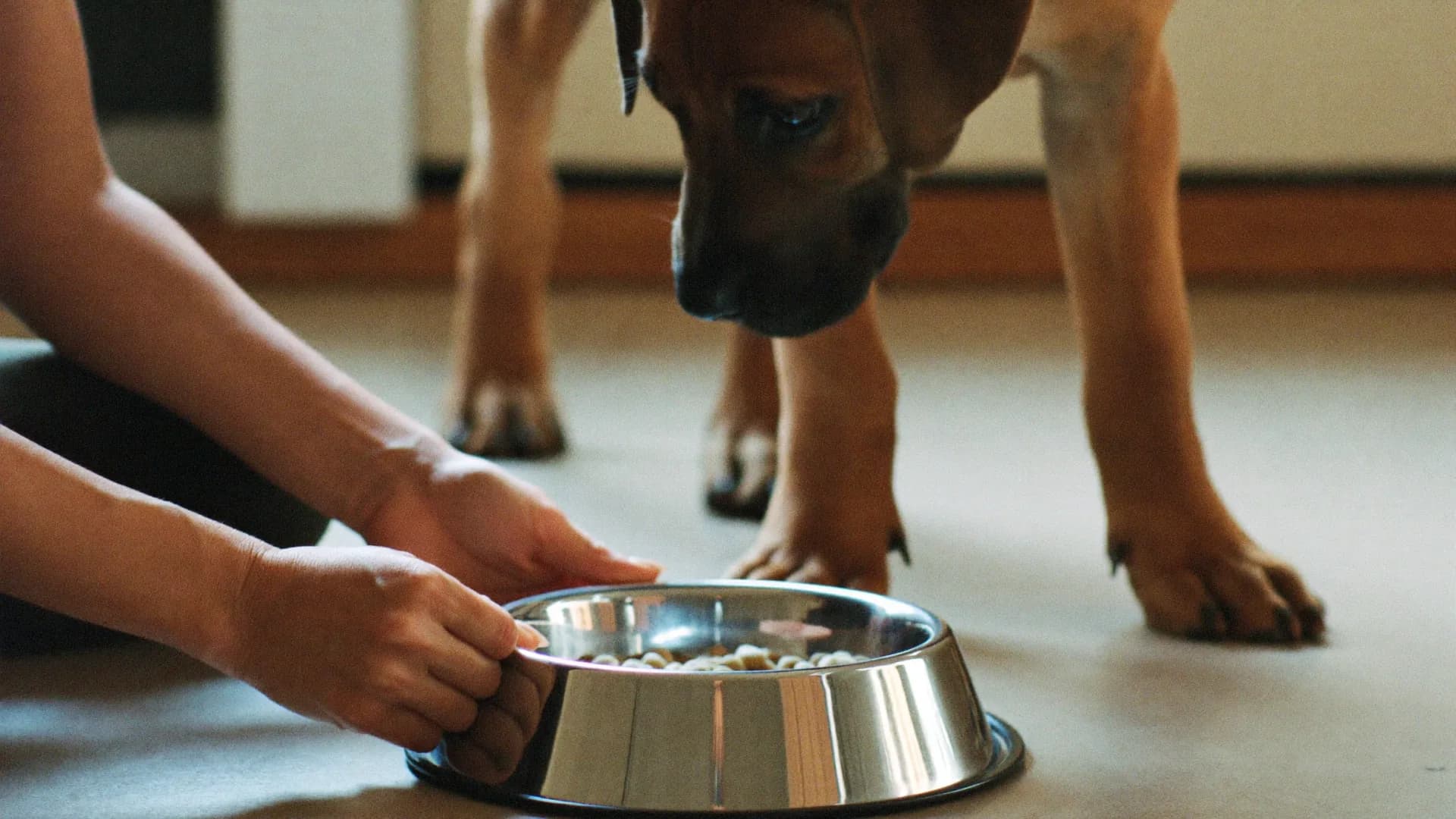
Feeding a large-breed puppy: why growth speed matters more than size
A giant-breed puppy grows for the better part of two years, and pushing that growth too fast strains a skeleton still under construction. The aim is steady growth, not the biggest puppy in the litter.
The advice that a puppy should eat as much as it wants is one of the more expensive things a new owner can believe, and it goes wrong fastest in the biggest breeds.
This is a practical overview, not a diet plan — the amounts and the timing belong to your own vet, who can weigh your dog and watch how it's growing.
A big puppy grows for longer, not just bigger
A small dog is close to its adult frame within a year. A giant one is still building bone for far longer, which means more months in which what it eats is turned straight into growth. That long window is exactly why the same feeding mistake shows up in a Great Dane or a Dogue de Bordeaux and rarely in a terrier.
The scale of the job is worth sitting with. A giant-breed puppy multiplies its birth weight many times over in its first year, laying down bone, cartilage and joint surfaces as it goes, and every one of those structures is soft and still forming while the dog is already heavy enough to load it. A terrier does the same work over a much shorter distance and with far less weight on top.
Why fast is the wrong target
Feeding a large-breed puppy for maximum growth — rich food, unlimited portions, extra calcium on top — makes it grow quickly, and quick is the problem.
A skeleton laid down in a hurry is more prone to the developmental joint and bone conditions these breeds already carry a risk of. The goal vets aim for is a lean, steady climb, where the frame has time to keep pace with the weight it will carry.
The conditions this is guarding against are worth naming, because they make the advice concrete rather than cautious. Hip and elbow dysplasia, where the joint doesn't form to fit; osteochondrosis, where cartilage fails to become bone properly; and a painful inflammation of the growing bone that shows up as a young giant-breed dog limping on one leg and then another. Genetics loads the gun on all of these, and growth rate is the part an owner can actually influence.
None of which means underfeeding. A puppy that isn't getting enough is a separate problem, and the target isn't thin — it's lean and even. Your vet can show you what that should feel like on your particular dog, and a monthly weigh-in plotted against the breed's expected curve is a better guide than any glance.
What actually helps
Three things do most of the work: a complete food formulated for large-breed puppies, which is built to slow growth rather than push it; measured portions instead of a full bowl; and keeping the puppy lean enough that you can feel its ribs.
Calcium supplements are a common own goal here — a balanced puppy food already has the right amount, and adding more can do harm rather than good. Every one of those is worth confirming with your vet for your particular dog.
What makes a large-breed puppy food different isn't marketing. It's usually lower in calories per mouthful, with calcium and phosphorus held to a tighter range and in a set ratio, so a hungry puppy can eat a satisfying volume without over-shooting on the minerals that build bone. That's also why 'adult food, more of it' and 'small-breed puppy food, scaled up' both miss the point.
Weigh the food rather than scooping it, since a scoop of the same volume can vary considerably by how it's packed, and feed several small meals a day while the puppy is young. Free-feeding — a bowl left down all day — is the single habit most likely to produce a fast-growing, over-conditioned giant puppy, because these breeds are frequently happy to keep eating.
Exercise, while we're on the subject
Feeding is half of the growth question and it's not much use on its own, because the same joints are being loaded from the outside at the same time.
A big puppy's growth plates stay open considerably longer than a small dog's, and until they close the joints are vulnerable to repeated impact. That means going easy on the things that concentrate force: long runs on hard ground, repeated jumping in and out of a car boot, stairs taken at speed several times a day, and hard games of fetch with sharp turns.
It doesn't mean keeping the dog still. Free play on grass at its own pace, swimming, and plenty of short walks are all good for it, and a bored giant puppy is a destructive one. The distinction is between activity the puppy chooses and stops when it's tired, and activity a human imposes at a fixed pace for a fixed distance.
The practical version: use a ramp for the car, carry a young puppy down stairs where you can, and save the running partnership until your vet says the skeleton has finished.
The neutering question, briefly
It belongs here because it changes the arithmetic twice over.
In large and giant breeds, neutering before the growth plates close can delay them closing, which alters how the limbs finish growing — one of the reasons vets increasingly discuss timing with owners of big dogs rather than booking the operation at six months by default. That's a conversation to have with your own vet, weighed against the reasons for neutering, and it's specific to the individual dog.
The second effect is simpler and catches almost everybody: a neutered dog's energy requirement drops, often noticeably, while its appetite doesn't. If nothing changes in the bowl, weight follows within a couple of months. Ask at the appointment what to reduce the portion to, and weigh the dog a few weeks later to check.
When to change to adult food
Later than for a small dog, and this is a question worth asking rather than guessing.
Small breeds move to adult food around their first birthday; the giants are often kept on a large-breed puppy or junior food well beyond it, because the growth they're still doing is exactly what the food is formulated for. Switching too early takes away that formulation while the dog is still building bone.
When the time does come, make the change gradually over a week or so, mixing increasing proportions of the new food into the old, since a sudden switch in a big dog's diet reliably produces a mess. And watch the body condition through the transition: a young adult giant breed that has stopped growing but is still eating puppy quantities gains weight quickly, and extra weight on those joints is the thing all of this was trying to avoid.
The breed pages carry the measured adult weights, so you can see what a puppy is growing toward before it gets there. What they can't do is set a portion: that depends on the individual animal, its food and its vet, and no page should pretend otherwise. Compare adult sizes on the breeds page.
When is a large-breed puppy fully grown?
The giant breeds keep filling out for roughly eighteen months to two years, far longer than a small dog. That long growth window is why what they eat as puppies matters so much.
What makes large-breed puppy food different?
It's usually lower in calories per mouthful, with calcium and phosphorus held to a tighter range and ratio, so a hungry puppy can eat a satisfying volume without overshooting the minerals that build bone. Adult food in larger quantities, or small-breed puppy food scaled up, doesn't do the same job.
Should I give my large-breed puppy a calcium supplement?
Usually not. A food formulated for large-breed puppies already carries the right balance, and adding calcium on top can raise the risk of skeletal problems rather than prevent them. Ask your vet before adding anything.
Is it better to keep a big puppy on the lean side?
Vets generally aim for lean and steady growth rather than a fast, heavy one, because it gives the joints time to keep up with the weight. Lean isn't thin, though — your vet can show you what it should feel like on your dog, and a monthly weigh-in beats a glance.
Can I leave food down for a large-breed puppy?
Better not. Free-feeding is the habit most likely to produce a fast-growing, over-conditioned giant puppy, since many of these breeds will happily keep eating. Weigh measured portions rather than scooping, and split them across several meals a day while the puppy is young.
How much exercise should a large-breed puppy get?
Plenty of free play at its own pace, and very little of the high-impact kind. Growth plates stay open longer in big breeds, so go easy on long runs on hard ground, repeated jumping out of a car, stairs at speed and hard fetch with sharp turns. Use a ramp, and save running together for a finished skeleton.
Does neutering affect a big puppy's growth?
It can. Neutering before the growth plates close may delay them closing and alter how the limbs finish growing, which is why vets increasingly discuss timing with owners of large breeds instead of booking at six months by default. It also lowers energy needs without lowering appetite, so the portion usually has to come down afterwards.
When should a large-breed puppy switch to adult food?
Later than a small dog — often well past the first birthday, since the growth the food is formulated for is still happening. Ask your vet, change over about a week to avoid an upset, and watch the weight afterwards, because a dog that has stopped growing but still eats puppy quantities gains quickly.