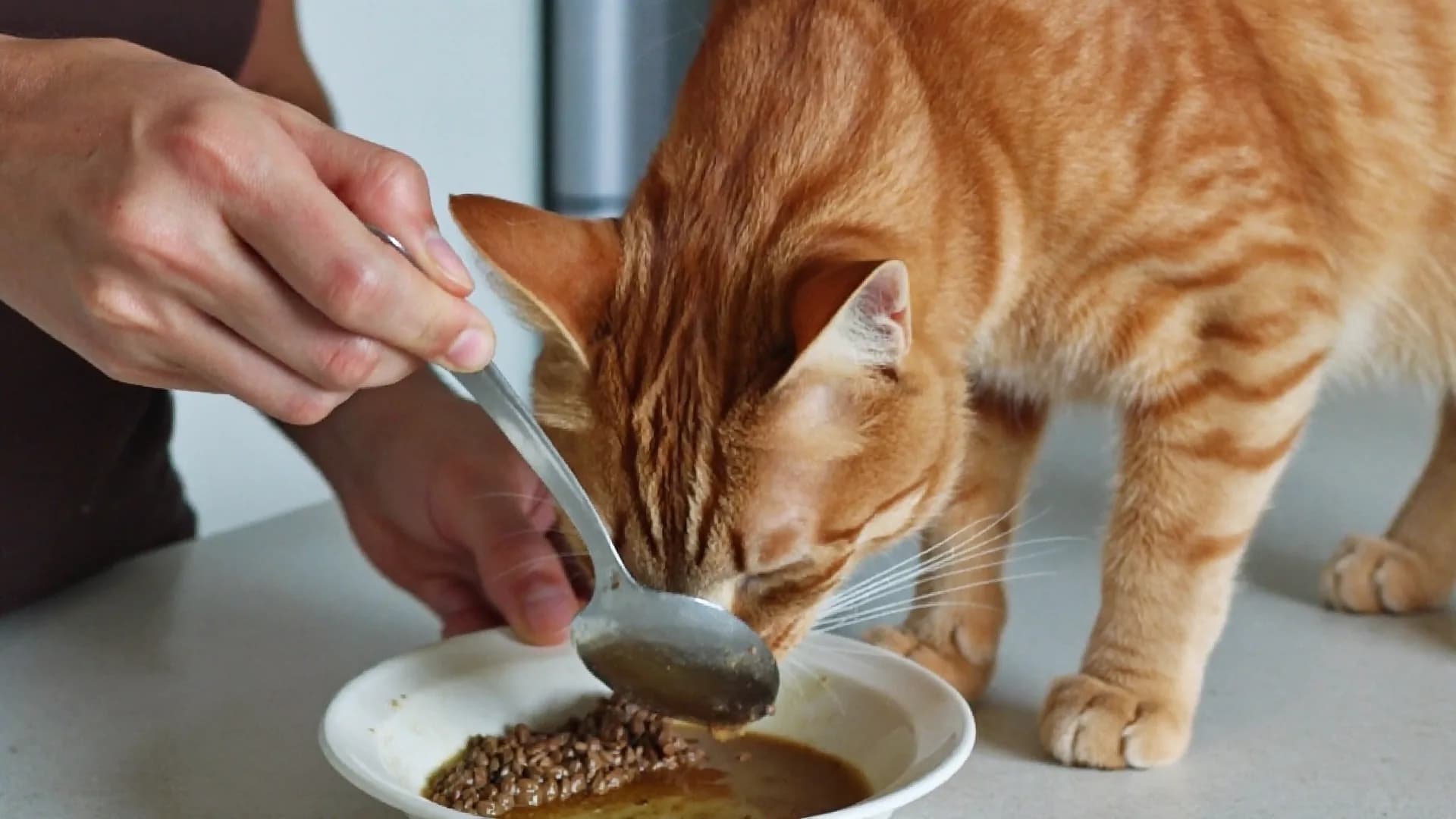
Wet or dry food for a cat: what actually matters
The wet-versus-dry argument is usually fought on the wrong ground. Two things genuinely matter — water and calories — and the popular idea that dry food cleans a cat's teeth is mostly a myth.
Ask ten cat owners which is better and you'll get a firm answer either way, most of it about things that barely move the needle.
Strip it back and the choice turns on water, on calories, and on how the food is served — and one of the most repeated arguments for dry food is simply not true.
Water is the real case for wet food
A cat's weak thirst drive is the whole reason this matters.
The domestic cat descends from a desert animal that took most of its water from prey, and it's poor at making up a shortfall by drinking. Wet food is roughly three-quarters to four-fifths water by weight, so a cat eating it takes in far more moisture than one crunching biscuits and topping up at the bowl.
For a cat prone to urinary trouble or with kidney disease, that extra water is the single strongest argument on the table, and it's the reason vets so often suggest moving such a cat onto wet food. For a healthy cat it's a smaller advantage, but it's still the one real advantage either side has.
It's worth being precise about the size of it. A cat on wet food takes in most of its daily water without ever visiting a bowl; a cat on dry has to find all of it there, and many simply don't drink enough to close the gap. That's why a water fountain and several bowls around the house matter more in a dry-fed house than a wet-fed one — and why the two approaches aren't equivalent for a cat with a urinary history.
The teeth myth
The most repeated case for dry food is that crunching it cleans the teeth. It mostly doesn't.
Ordinary kibble shatters on first contact instead of scrubbing along the gumline, and the plaque that causes disease sits at the gum margin where a shattered biscuit never reaches. Cats fed dry food get dental disease at rates that make the claim hard to sustain. What does work is brushing, veterinary cleaning under anaesthetic, and the specific dental diets and chews designed with a texture and size that actually shear along the tooth — a much narrower category than dry food in general.
Cats also get a dental problem that has nothing to do with plaque at all: tooth resorption, where the tooth is dissolved from the outside in. It's painful, it's common, and no food of any kind prevents it. That's one more reason to treat the mouth as something a vet checks rather than something the diet handles.
Calories, and how free-feeding quietly adds weight
Dry food is energy-dense, keeps all day in a bowl, and is therefore usually left out — and that combination is how a great many cats become overweight.
It's less about the food than the method: a bowl topped up whenever it looks low has no portion at all, and a cat that grazes twenty times a day is eating on appetite rather than on need.
Wet food is lower in calories for its bulk and is served in portions by its nature, which imposes the discipline that a full bowl removes. If you feed dry, the fix isn't necessarily to switch: it's to weigh the day's ration in the morning and let that be the whole day's food. The calorie statement on the pack is what makes that possible, and reading the label explains where to find it.
Grazing itself isn't the problem, and it suits how cats evolved to eat — a wild cat takes many small meals a day. What causes trouble is grazing from an unmeasured supply. A timed feeder loaded with the weighed daily amount gives a cat the pattern it prefers while keeping the total fixed, which is usually a better answer than forcing two large meals on an animal built for ten small ones.
Comparing the two fairly
Almost every comparison of protein or fat between a tin and a bag is wrong, because the tin is mostly water.
To compare them you have to take the water out on paper: subtract the moisture from 100, divide the nutrient by what's left, multiply by 100. Done properly, plenty of wet foods are higher in protein and lower in carbohydrate than the kibble they're being compared against — which is the opposite of the impression the printed percentages give.
The same correction applies to price. Cost per kilogram flatters dry food enormously, because you're buying water in the tin and not in the bag. Cost per day of feeding is the honest comparison, and while dry food usually still wins it, the gap is smaller than the shelf price suggests.
What actually suits the cat
Texture preference forms early.
A kitten raised on one form often refuses the other as an adult, which is an argument for offering both while a cat is young instead of discovering at ten that it won't eat wet food when its kidneys need it. An adult cat that has only ever eaten dry can usually still be converted, slowly and with patience, but it's work you'd rather have done in advance.
Individual circumstances decide the rest. A cat that needs to lose weight does better on measured wet meals. A cat left alone all day may need food that keeps, or a timed feeder. A cat with a sore mouth finds wet food easier. A cat on medication often takes it more readily in something soft. And a multi-cat house where one is overweight and one isn't needs separated feeding more than it needs a different food.
Age shifts it too. A senior cat that's losing weight, or one with reduced appetite, is often easier to tempt with wet food warmed slightly, and the extra water suits kidneys that are working harder than they used to. A young, lean, active cat with no history is the one case where the choice genuinely doesn't matter much, and convenience is a legitimate tie-breaker.
Practical middles
Plenty of owners land on a mix, and it's a reasonable answer and not a fudge: wet food once or twice a day for the water and the portion control, a weighed amount of dry for convenience and cost. Count both towards the same daily total, or the mix simply becomes two dinners.
Wet food left out spoils, faster in warm weather, so put down what will be eaten and take up what isn't. Dry food goes stale and rancid once opened — keep the bag sealed inside a container instead of tipping it loose into one, since the bag is a moisture barrier and the container usually isn't. Whichever way you go, change food gradually; cats are more neophobic about food than dogs and a sudden swap is how a fussy cat becomes a cat that isn't eating at all.
A few small mechanics make either form work better. Feed from a wide shallow dish, so a cat's whiskers aren't pressed against the sides. Keep the bowl away from the litter tray and, in a multi-cat house, away from the other cat's. Warm wet food to about room temperature instead of serving it straight from the fridge, since cold food smells of almost nothing and smell is most of what a cat is judging. And wash the bowls daily, which matters more for wet food than people assume.
What this cannot settle
There's no evidence that either form is better for every cat, and anyone claiming otherwise is arguing past the data.
What is well established is narrower: cats hydrate poorly, hydration matters for the urinary tract and kidneys, dry food is easier to overfeed, and kibble doesn't clean teeth. Everything after that depends on the animal in front of you — and if that animal has a weight problem, a urinary history or kidney disease, this is a decision to make with a vet and not from an article. A cat that stops eating for more than a day is a separate and urgent matter, covered in when a cat stops eating.
Is wet or dry food better for cats?
Neither wins outright for every cat. Wet food helps with hydration, which matters a great deal for a species that drinks poorly, and it comes in portions; dry is cheaper and more convenient but easier to overfeed. Many cats do well on a mix, and a cat with a weight, urinary or kidney issue is one to decide with a vet.
Does dry food clean a cat's teeth?
Largely no. Most kibble shatters on first contact instead of scrubbing the gumline, and does little about the plaque that causes disease. What works is brushing, veterinary cleaning, and the specific dental diets and chews designed to shear along the tooth — not dry food in general.
Why does hydration matter so much for cats?
The domestic cat descends from a desert animal that took most of its water from prey, and it's poor at making up a shortfall by drinking. Low water intake strains the urinary tract and kidneys, and wet food delivers water with the meal, which sidesteps the problem.
Is it bad for a cat to graze all day?
The grazing isn't the problem — many small meals is how cats evolved to eat. The problem is grazing from an unmeasured supply. A timed feeder loaded with the weighed daily amount gives a cat the pattern it prefers while keeping the total fixed.
How do I compare protein in wet and dry cat food?
Convert both to a dry-matter basis, because the tin is mostly water. Subtract the moisture from 100, divide the nutrient by the result and multiply by 100. Done that way many wet foods are higher in protein than the kibble they're compared with, which is the opposite of what the printed percentages suggest.
Is dry food cheaper than wet food?
Usually, but by less than the shelf price implies, because cost per kilogram makes you pay attention to water you aren't buying in a bag. Compare cost per day of feeding using the calorie statement on each pack, which is the only fair basis.
Can I feed my cat both wet and dry food?
Yes, and many owners do. Feed wet once or twice a day for the water and the portion control and a weighed amount of dry for convenience — but count both towards one daily total, otherwise the mix becomes two dinners and the cat gains weight.
Does it matter how I serve the food?
More than you'd think. Use a wide shallow dish so the whiskers aren't pressed against the sides, keep it away from the litter tray and from another cat's bowl, and warm wet food to room temperature instead of serving it from the fridge — cold food smells of almost nothing, and smell is most of what a cat judges.
My cat will only eat dry food. Can I change that?
Usually, slowly. Texture preference forms in kittenhood, so a cat raised on dry may refuse wet at first; small amounts alongside the usual food, warmed slightly to lift the smell, converts most cats over weeks. It's far easier done before the cat needs it than after.