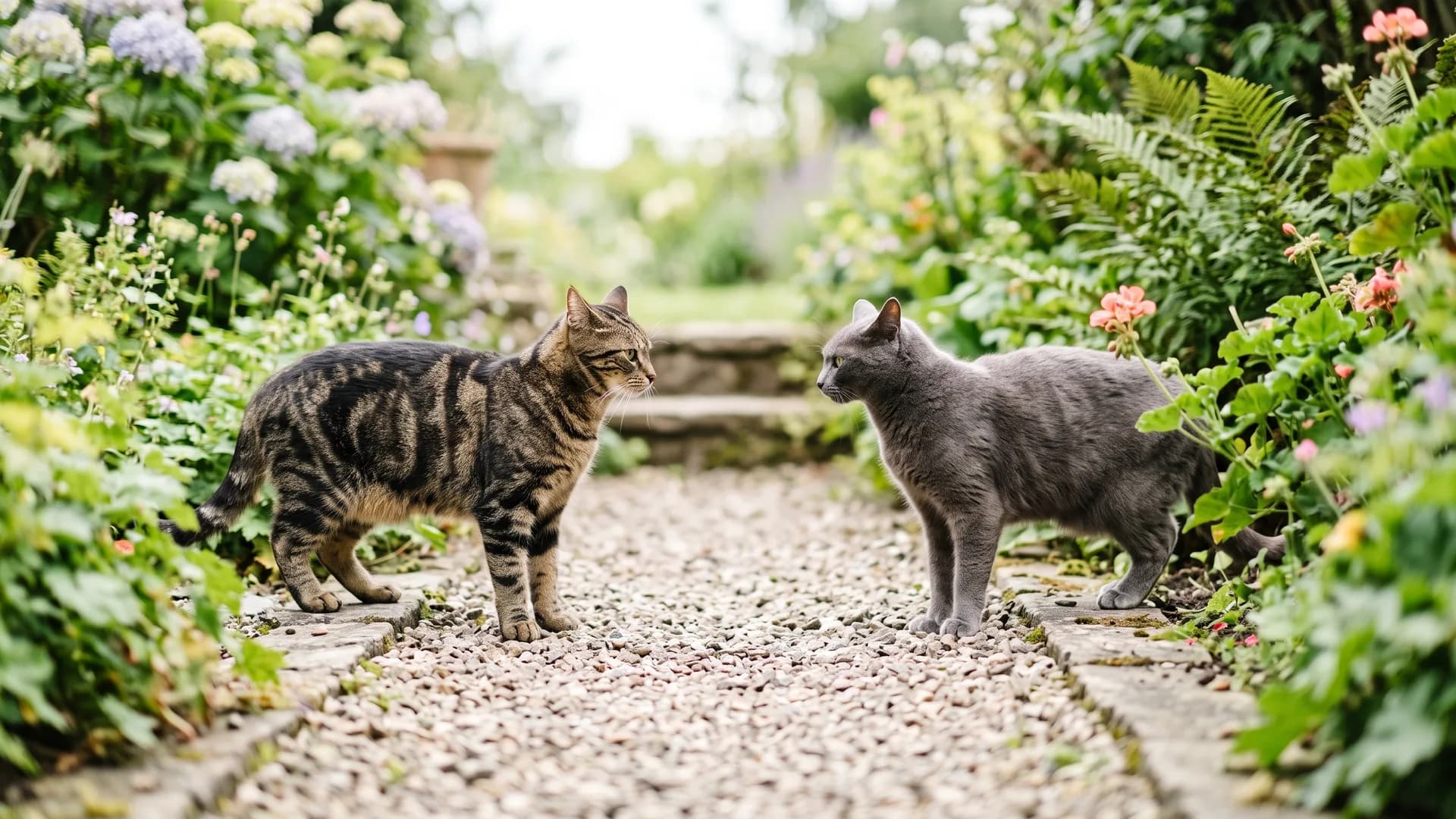
Why cats fight, and how to calm the tension between them
Cats that once got along can fall out, and cats introduced badly may never settle — but most household cat conflict traces to competition, fear or a poor introduction, each of which has a way back.
Two cats hissing, chasing and screaming through the house is stressful for everyone, and it is easy to assume the cats simply hate each other or that one is trying to be boss. Neither is usually the real story. Cats are not naturally group animals the way dogs are, so living together is something many of them tolerate rather than crave, and most conflict comes down to competition, fear or an introduction that went wrong — each of which has a route back to peace.
Play, or a real fight?
Before you treat a problem, make sure there is one. Cats that are playing chase each other in near-silence, take turns being the one who pounces, pause and reset, and walk away loose and relaxed afterwards. A real fight is loud — hissing, growling, yowling — with flattened ears, puffed-up fur, swatting with claws out, and sometimes injuries, and one cat that consistently hides, flinches or avoids the other. If the interactions are silent, mutual and role-swapping, that is rough play; reading their body language tells you which you are looking at.
The common causes
Real conflict usually has one of a handful of roots. A rushed or botched introduction is the classic, leaving two cats permanently braced against each other. Competition for resources — food, water, litter trays, resting spots, warm windowsills, even your attention — manufactures fights where there is not enough to go around. Redirected aggression is another: a cat wound up by an outdoor cat it cannot reach lashes out at the nearest housemate instead. And fear, or a change in one cat through pain or illness, can turn a settled pair tense seemingly overnight.
Resources: the fix people skip
The most overlooked cause is the easiest to fix. Cats fall into conflict when they have to compete for or queue at the things they need, so provide one of each key resource per cat plus one — separate food and water stations, enough litter trays, and plenty of beds and high perches — and spread them around the home rather than clustering them in one room. Vertical space matters especially: cat trees and shelves let a nervous cat get up and away, and let two cats share a room without being forced into each other's path. Take away the scarcity and you take away a great deal of the fighting.
Never let them 'fight it out'
It is a stubborn myth that cats will settle their differences if left to it. They will not — letting cats fight entrenches the hostility and risks injuries and infected bite wounds. Interrupt a fight without getting hurt: never reach in with your hands, because a cat in that state will redirect a bite onto you, but break the tension with a loud clap, a cushion between them or a towel dropped over one, then separate them into different rooms to calm down completely before any contact resumes.
Re-introduction when it has broken down
When two cats are genuinely feuding, the way back is to treat them like strangers and start the introduction over. Separate them into different parts of the home, swap bedding and scent between them, and feed them on either side of a closed door so good things happen in each other's presence at a safe distance. Then rebuild slowly to controlled visual contact and finally supervised time together, retreating a step at any sign of real tension. It is the same patient, scent-first process as introducing a new cat, and rushing it is what caused the problem the first time.
When it is sudden or severe
Fighting that erupts suddenly between cats that were fine, or one cat that has become unusually aggressive, is worth a vet visit — pain and illness make cats short-tempered, and a hurting cat that lashes out is telling you something a behaviour plan alone will miss. Cats that lunge or bite hard enough to injure, or a feud that will not ease despite resources and a careful re-introduction, are a good case for a qualified feline behaviourist. And bear in mind that some cats, however well you manage it, are happiest as the only cat — recognising that is kinder than forcing a peace that will never come. The same handling caution applies as with a cat that bites when petted: never punish, and give space rather than pushing.
Managing a feud day to day
While you work on the underlying relationship, day-to-day management keeps the peace and prevents rehearsal, because every fight makes the next one more likely. Keep the cats apart when you cannot supervise, use height and separate rooms so each has somewhere to be that the other is not, and watch for the flashpoints — a narrow doorway, the single food bowl, the one sunny windowsill — and defuse them by adding duplicates and widening the routes between resources. If one cat corners or stalks the other, give the victim safe zones it can reach and the aggressor cannot follow, such as a high shelf or a room behind a gate. Reducing the number of tense encounters is half the work; the calmer the cats are day to day, the faster a re-introduction takes hold.
Why do my cats suddenly fight when they used to get along?
Look for a change: a new pet, person or baby, a move or building work, an outdoor cat at the window winding one of them up, or a resource that has become scarce. Pain or illness in one cat can also turn a settled pair tense, so a sudden shift is worth a vet check as well as a look at what changed.
Are my cats playing or fighting?
Play is near-silent, mutual and takes turns — they chase, pause, swap who pounces and walk away relaxed. A fight is loud, with hissing, flattened ears, puffed fur and claws out, and one cat that keeps hiding or avoiding the other. If it is silent and even, it is play; if it is loud and one-sided, it is conflict.
How do I stop my cats fighting?
Start with resources: one of each — food, water, litter trays, beds, high perches — per cat plus one, spread around the home so nobody has to compete. Block the sight of outdoor cats, keep routines steady, and if the relationship has broken down, separate them and re-introduce slowly, scent first. Never punish, which only raises the tension.
Should I let my cats fight it out?
No. Cats do not resolve conflict by fighting — letting them entrenches the hostility and risks injuries and infected bites. Interrupt without using your hands (a clap, a cushion, a towel), separate them to calm down, and rebuild the relationship gradually rather than hoping they will sort it out themselves.
Will two cats ever get along?
Many will, with enough space, enough resources and a slow re-introduction, though some settle into a polite truce rather than a friendship, which is a perfectly good outcome. A few cats are genuinely happier alone, and recognising that is fairer than forcing a bond. Patience and a well-set-up home decide most cases.
Can cats fight to establish a pecking order?
Cats do not have a fixed dominance hierarchy the way the popular idea suggests, so letting them fight to 'sort out who is boss' does not work — it just entrenches the conflict. What looks like a struggle for rank is usually competition for resources or fear, both of which ease when there is enough to go around and enough space to keep apart, not when one cat 'wins'.