Cat spraying and urine marking: why it happens and how to stop it
Spraying is not a litter-box failure — it is a cat leaving a message, usually about stress or territory. Telling the two apart is the whole first step, because the fixes are completely different.
Few things test a cat owner's patience like finding urine sprayed up a wall or a door frame. It is easy to read as spite or a toilet accident, and easy to punish, and both reactions make it worse. Spraying is communication — a cat leaving a scent message about territory or stress — and it is a different behaviour from a cat failing to use its litter tray. Working out which one you are dealing with is the whole first step, because the two have completely different solutions.
Spraying is not the same as house-soiling
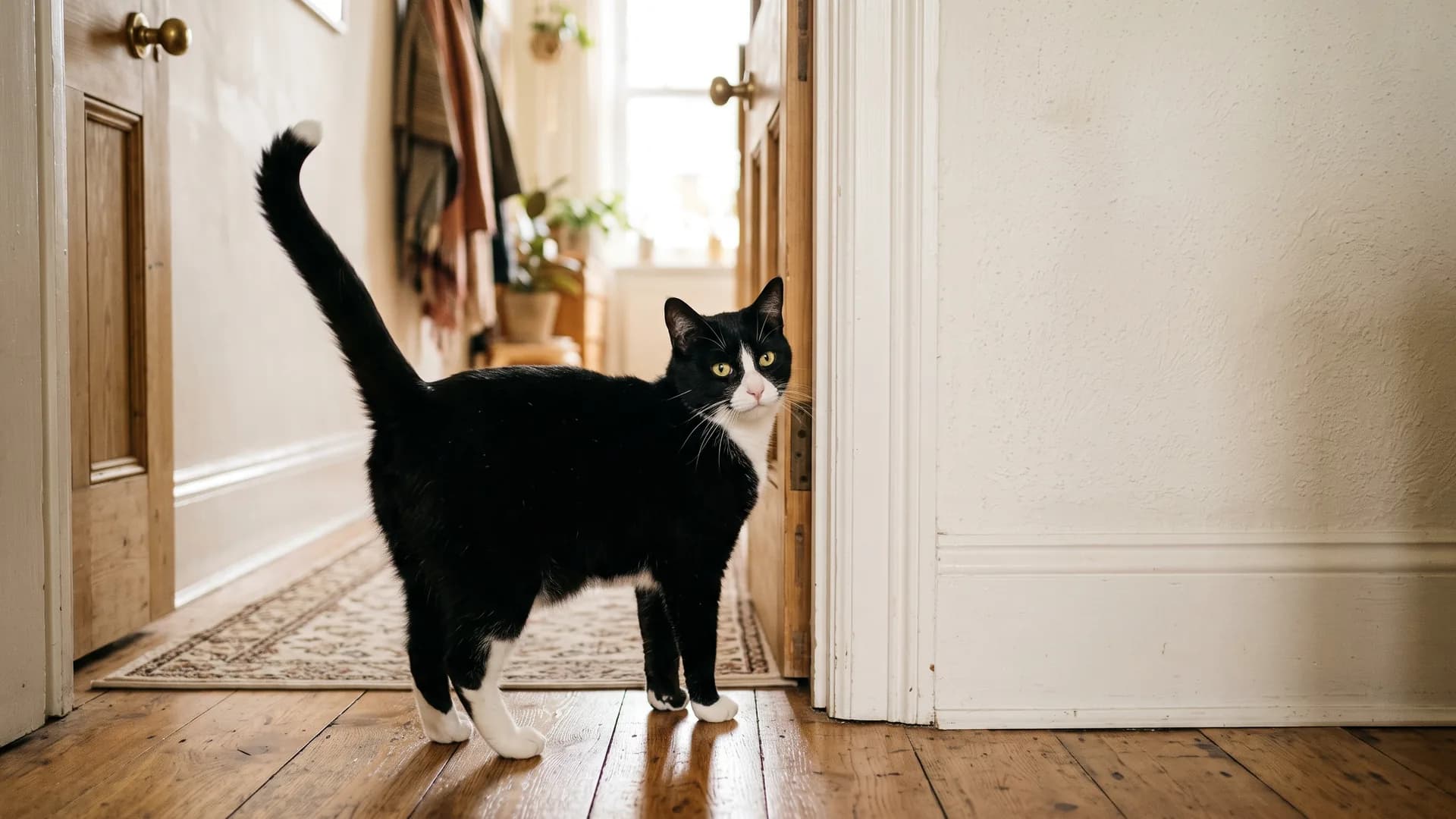
The clearest sign is the posture and the surface. A spraying cat stands upright, backs up to a vertical surface — a wall, a door, the side of the sofa — with its tail up and often quivering, and leaves a small amount of urine as a marker. A cat that squats and leaves a puddle on the floor or the bed is not spraying; it is avoiding its tray, which is a litter-box problem with its own causes and fixes. Getting this distinction right saves you solving the wrong problem.
What spraying actually is
Spraying is a normal part of feline communication, not a character flaw or a dirty habit. Cats mark to stake out territory, to advertise for mates, and to self-soothe when something has unsettled them, and the message is aimed at other cats as much as at anything. Both males and females do it, but it is far more common in cats that are not neutered and in homes that feel crowded or stressful to the cat. Understanding that the cat is talking, not misbehaving, changes how you respond to it.
Neutering is the biggest single factor
Intact cats spray far more than neutered ones, driven by mating and territorial urges, and neutering greatly reduces or stops the behaviour in the great majority of cats, often quickly. If your spraying cat is not yet neutered, that is the first and most effective step, and the earlier it is done the less likely spraying is to become an established habit in the first place. It is worth arranging with your vet before trying to manage the behaviour any other way.
Stress and territory are the usual triggers
In neutered cats, spraying almost always traces to stress or a threat to territory. A new cat, pet, partner or baby; a house move; building work; a change in routine; and — very commonly — the sight of an unfamiliar cat through the window all unsettle a cat enough to make it mark. Conflict between the cats already in the home is another frequent cause, closely tied to tension between housemates. The cat is not being difficult; it is trying to make its world feel secure again by covering it in its own scent.
Reduce the stress and the competition
So the fix is to make the cat feel safe and unthreatened rather than to police the marking. Give plenty of resources — food, water, litter trays, and resting and high perching spots — spread around the home and not clustered, on the rule of thumb of one of each per cat plus one, so no cat has to compete or feel cornered. Block the view of outdoor cats at the windows they patrol, keep routines steady, and consider a synthetic feline pheromone diffuser, which helps some cats settle. A cat with plenty of secure territory has far less reason to mark it. Reading its body language helps you spot what is stressing it.
Clean it right, and never punish
How you clean matters, because a spot that still smells of urine invites the cat back to refresh the mark. Use an enzymatic cleaner made for pet urine, which breaks down the proteins ordinary cleaners leave behind; never use an ammonia-based product, which smells like urine to a cat and positively encourages re-marking. And do not punish a spraying cat — punishment raises the stress that is usually driving the behaviour, so it makes the very thing you are trying to stop more likely, as well as damaging your relationship with the cat.
When to see the vet
Spraying that appears suddenly, especially in a cat that has never done it, deserves a vet visit before you assume it is behavioural. Urinary problems and pain can cause a cat to urinate outside the tray or in unusual spots, and a medical issue masquerading as marking needs treating, not managing. Once illness is ruled out, an entrenched spraying habit — particularly in a multi-cat home — is a good case for a qualified feline behaviourist, who can untangle the specific stress behind it. It often overlaps with sorting out introductions that did not go smoothly.
Multi-cat homes and the extra pressure
Spraying is far more common where several cats share a space, because every extra cat raises the competition and the chance of one feeling crowded or threatened. The cats may look as if they are coping while one of them quietly marks the boundaries it cannot defend openly. The remedy is the same principle scaled up: more of everything, spread further apart, so no cat has to pass another to reach food, water or a tray, and plenty of separate high perches and hiding places so a nervous cat can keep its distance without confrontation. Where the spraying is tangled up with open hostility between the cats, the marking usually eases only once that relationship is calmed, which is a project in itself rather than a quick clean-up.
Why is my cat spraying?
To leave a scent message — about territory, mating, or stress. In neutered cats it is almost always stress or a threat to territory: a new pet or person, a move, an outdoor cat seen through the window, or conflict with another cat in the home. It is communication, not spite or a litter-box miss.
What is the difference between spraying and peeing outside the litter box?
A spraying cat stands, backs up to a vertical surface with a quivering tail and leaves a small marker; a cat avoiding its tray squats and leaves a puddle on a horizontal surface. The first is territorial communication; the second is a litter-box problem. They look different and are fixed in completely different ways.
Does neutering stop cats spraying?
It greatly reduces or stops it in most cats, because much of the drive to spray is hormonal. Intact cats spray far more, and neutering — especially before the habit is established — is the single most effective step. If your spraying cat is not neutered, that is the first thing to arrange with your vet.
How do I clean cat spray so they don't do it again?
Use an enzymatic cleaner made for pet urine, which breaks down the proteins that keep drawing the cat back. Never use an ammonia-based cleaner, which smells like urine to a cat and encourages re-marking. Clean promptly and thoroughly, and do not punish the cat, which only adds the stress that drives spraying.
My cat suddenly started spraying — why?
A sudden change is worth a vet visit first, because urinary problems and pain can cause urine-marking or unusual toileting that looks behavioural. If the cat is healthy, look for a new stress: a new pet, person or baby, a move, building work, an outdoor cat at the window, or conflict with another resident cat.