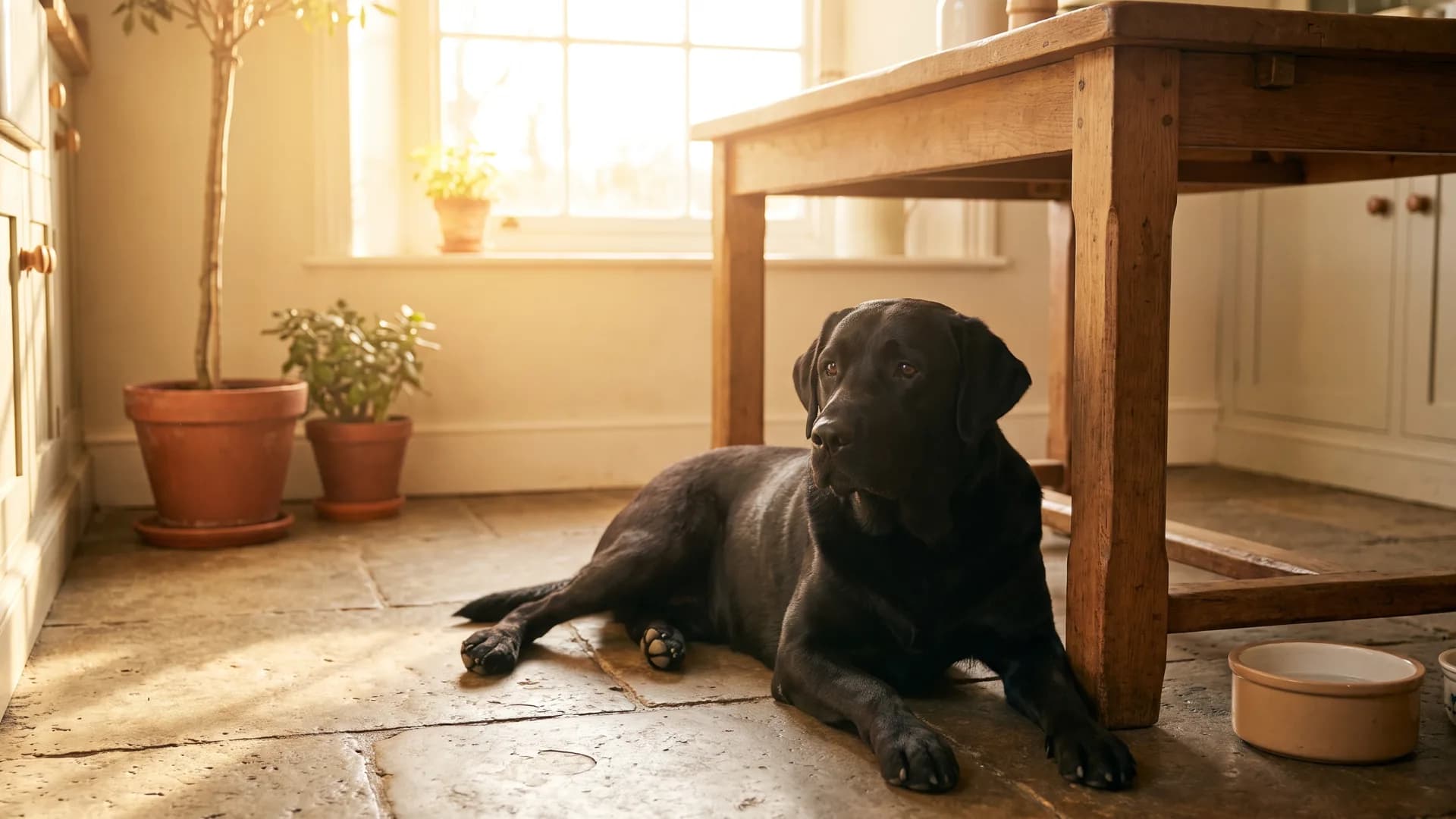
How long can a dog be left alone?
Four hours is the figure most often quoted for an adult dog, and it is a guideline rather than a rule — what actually decides it is the dog's age, its bladder, and whether being alone is boring or frightening.
For a healthy adult dog, around four hours is the figure most commonly given, and up to six or eight is manageable for some dogs with the right routine either side. Those numbers are guidelines rather than a standard, and treating them as a rule misses the two questions that actually matter: can the dog physically wait that long, and does being alone frighten it?
A dog that is comfortable alone and empty-bladdered can manage a working day with a break in the middle. A dog that panics the moment the door closes cannot manage twenty minutes, and no amount of building up will fix that until the panic is addressed.
Puppies: the bladder does the arithmetic
With a young puppy the limit is physical and short. The rule of thumb trainers use is roughly one hour per month of age, up to a maximum of a few hours — so a three-month-old puppy is a three-hour dog at the outside, and that is the bladder speaking rather than the temperament.
A puppy left past that limit does not learn patience. It learns that it has to toilet indoors, which then has to be untrained. If your household cannot cover the daytime in the first months, that is worth solving before the puppy arrives rather than after — a midday visit from a neighbour, a walker, or a staggered work pattern.
Adult dogs: what four hours assumes
The four-hour figure assumes a dog that has been exercised, has toileted, has water, and is comfortable in the space it is left in. Change any of those and the number changes with it. A dog left after a long walk and a meal will usually sleep through most of the absence; the same dog left with unspent energy at nine in the morning will find something to do, and you will not like what it chooses.
Older dogs often need shorter gaps rather than longer ones, because bladder control declines and stiffness makes long stretches in one position uncomfortable. A dog that managed six hours at four years old may need a break at four hours by twelve.
Boredom and fear look different
This distinction decides which fix works, and it is the one thing most often missed. A bored dog chews, digs, barks intermittently, and is otherwise fine — it settles between episodes and greets you normally. A dog with genuine separation distress is different in kind: it panics as you prepare to leave, it may drool, pace, howl continuously or toilet indoors despite being house-trained, and the destruction is usually concentrated at the door or window rather than spread around.
Boredom responds to exercise, enrichment and something to do. Distress does not — enrichment left with a panicking dog usually comes back untouched, because a frightened animal does not eat. If what you are seeing looks like fear rather than mischief, separation anxiety needs its own approach and often professional help.
Building up the time
Time alone is trained like anything else: in increments the dog can succeed at. Start with departures so short they are unremarkable — pick up the keys, step out, come back in ten seconds — and lengthen only while the dog stays relaxed. The point is not the duration, it is that leaving stops predicting a long absence.
Keep departures and returns undramatic. A long emotional goodbye and a loud reunion both raise the stakes of the door, which is the opposite of what you want. Leave and return as though nothing has happened.
A crate helps some dogs and traps others. For a dog that already sees a crate as its own space it can make an absence calmer, and crate training done properly is a genuine kindness. For a dog with separation distress, shutting it in usually makes the panic worse rather than containing it.
Setting up the absence
Do the boring things first: a walk before you go, a toilet break, fresh water in a bowl that cannot be tipped, and a room the dog is safe in. Then give it something to do — a food puzzle or a stuffed toy that takes twenty minutes buys a calm start to the absence, which is when most trouble begins.
Leave the space genuinely dog-proof rather than tidy. Chewable cables, medication, food left within reach and anything the dog can swallow are the real hazards, and pet-proofing a home matters more when nobody is in it. Background sound helps some dogs and does nothing for others; it is worth trying and not worth relying on.
When the answer is not a longer stretch alone
Sometimes the honest conclusion is that the dog needs company rather than better preparation. A midday walker, doggy daycare a couple of days a week, or a neighbour dropping in changes an eight-hour absence into two four-hour ones, and that is a different day for the dog. It is also the realistic answer for puppies, seniors and dogs that have never coped alone.
If you leave regularly for a full working day and the dog is showing distress rather than boredom, the schedule is the problem and no product fixes it.
Cats are a different question
Cats tolerate solitude far better than dogs, and the limit for them is usually resources rather than company — litter, water, food and safety. That does not make them indifferent, and a cat left for days with a full bowl is not being cared for. For absences longer than a day, arrange visits; boarding or a sitter covers how to choose.
How long can an adult dog be left alone?
Around four hours is the usual guideline, and some settled dogs manage six to eight with a walk and a toilet break either side. It depends on the individual dog, its age and whether it is comfortable alone — the number is not a standard.
How long can a puppy be left alone?
Roughly one hour per month of age, up to a few hours at most. A three-month-old puppy is a three-hour dog at the outside, and that limit is about bladder control rather than temperament. Left longer, a puppy learns to toilet indoors.
Can I leave my dog alone for 8 hours?
Some settled adult dogs manage a full working day if they are walked and toileted before and after, but it is a long stretch and it does not suit puppies, seniors or anxious dogs. A midday visit turns one eight-hour absence into two four-hour ones, which is a materially better day for the dog.
How do I know if my dog is bored or anxious when alone?
Boredom looks like intermittent chewing, digging or barking from a dog that is otherwise fine and settles in between. Distress looks like panic: pacing, drooling, continuous howling, indoor toileting from a house-trained dog, and damage concentrated at the door. They need different solutions.
Does leaving the TV or radio on help a dog?
It helps some dogs and does nothing for others. It is cheap to try and it is not a substitute for exercise, a toilet break or company — treat it as a small comfort rather than a solution to a long absence.
Should I crate my dog while I am out?
For a dog that already treats a crate as its own space it can make an absence calmer. For a dog with separation anxiety it usually makes the panic worse, because confinement is not the thing it is frightened of. Never use a crate as a way to extend how long a dog is left.
How long can a cat be left alone?
Longer than a dog, because the limit is resources rather than company: litter, water, food and a safe space. Even so, a cat left for more than a day should be visited, not simply left with a full bowl.