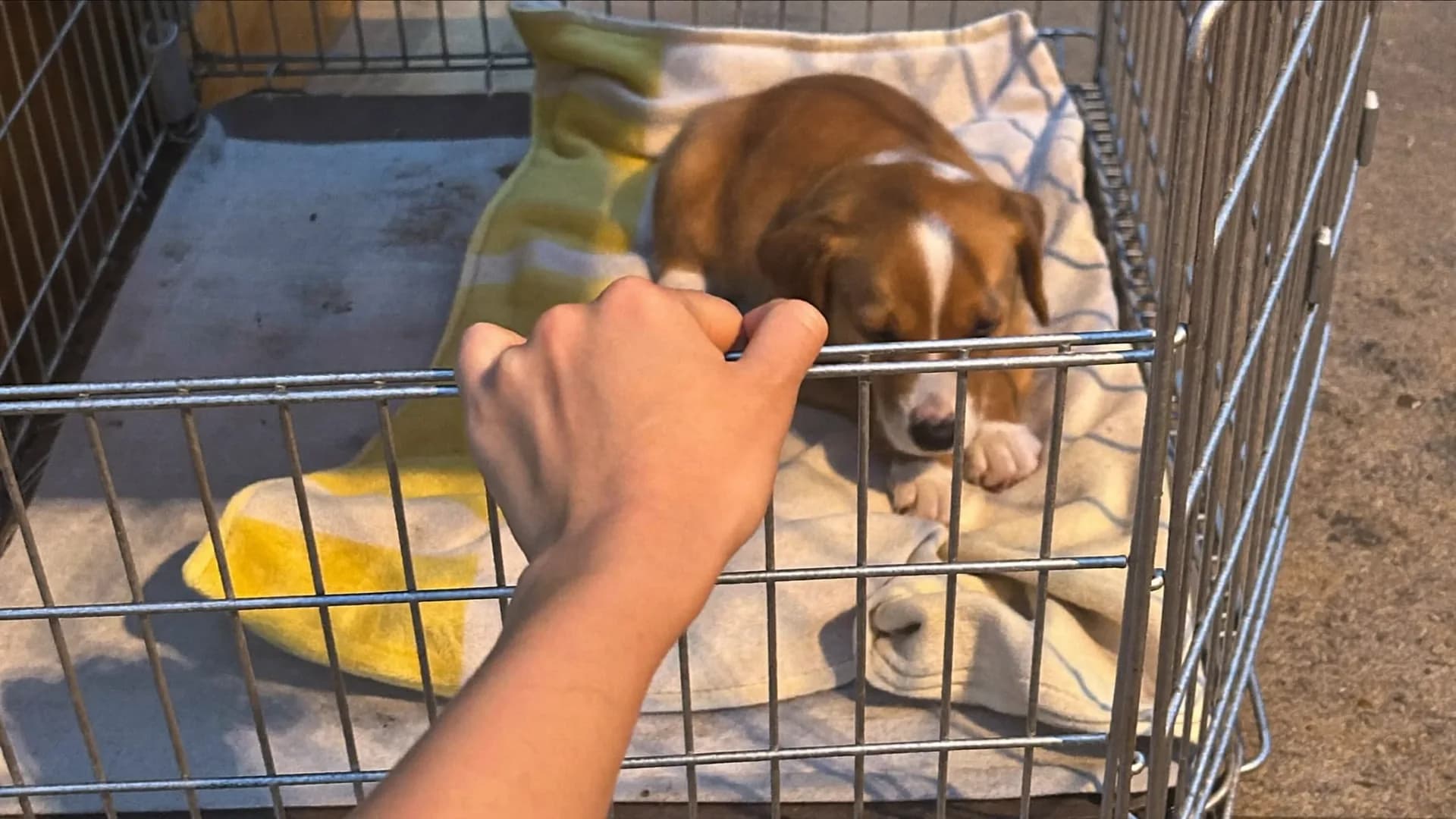
Crate training a puppy: a den, not a cage
Used well, a crate gives a puppy a safe place of its own and makes house-training easier; used badly it's just a box a dog dreads. The difference is entirely in how you introduce it.
A crate divides opinion because it can be either of two very different things.
Introduced with a little patience it becomes a den a puppy chooses for itself. Used as somewhere to shut a dog away, it becomes a punishment it can't leave. The equipment is identical. The training decides which one you end up with.
Get the size and the place right first
A crate should be big enough for the puppy to stand up without ducking, turn round, and lie fully stretched out.
Much bigger than that and it stops working for toilet training, because a puppy that can soil one end and sleep at the other has no reason to hold on. For a breed that will treble in size, buy the adult size with a divider rather than buying twice.
Put it where the family is — a corner of the living room to start with, not a utility room with the door shut. The point of a den is that it's a safe place near the group, and a puppy sent somewhere isolated learns that the crate means separation. Later it can move; at the beginning, proximity is doing half the work.
Make it somewhere good to be
Leave the door open and let the puppy explore in its own time. Feed its meals inside, with the door still open. Drop treats in when it isn't looking, so it finds them there on its own. Put comfortable bedding in, and a chew that only exists in the crate.
None of this is a trick — you're simply arranging for every experience of the crate to be a pleasant one before the door ever closes.
Resist shutting the door early even when the puppy seems happy. The most common way this goes wrong is a good first day followed by an ambitious second one, and a puppy that has been trapped once approaches the crate differently from then on.
Never use the crate in anger. A puppy that gets put there as a consequence stops trusting it, and once the safe place is gone it's difficult to get back.
Closing the door, in seconds
When the puppy goes in happily, close the door for two or three seconds while it's eating, and open it before there's any fuss.
That order matters: you want the door opening to be unremarkable rather than a rescue. A puppy let out because it complained has learned exactly what complaining is for.
Build to ten seconds, then a minute, then a few minutes, sitting beside the crate. Only then start moving away — stand up, cross the room, step out of sight for a moment, come back.
Vary the durations rather than climbing steadily upward, and end every session while it's still going well. The pace is the puppy's rather than the calendar's, and a session that ends in panic costs more than three good ones gain.
Nights, and the bladder arithmetic
Nights are easier with the crate in your bedroom for the first weeks. A puppy that can hear you settles faster, and you'll hear it when it needs to go out — which it will, because a young puppy physically can't last the night early on. Take it out, keep the trip boring and dark, and put it straight back.
In the daytime the same limit applies: the rule of thumb is roughly one hour per month of age, a few hours at most, and that's the bladder speaking rather than the temperament. A crate is a bed rather than cover for a working day, and hours shut in guarantee both an accident and a distressed dog. How long a dog can be left alone sets out the fuller version.
One practical note about the first few nights: they are usually worse than anybody warns you, and they pass faster than you'd think. A puppy that has just left its mother and littermates is sleeping alone for the first time in its life, and a hand resting where it can be seen through the bars does more than any amount of firmness.
Whining: need, protest, or panic
Three different things sound similar through a wall.
A puppy that whines, is taken out, toilets and settles was telling you something. A puppy that whines for a minute at bedtime, having just been out, is protesting and usually settles if the room is quiet and nobody makes an event of it. A puppy that escalates rather than settling — frantic, panting, throwing itself at the door, still going after several minutes — is panicking, and that's a signal to open the door and go back several steps in the training.
The old advice to ignore all of it treats those three as one thing. It's right about the middle case and wrong, sometimes badly, about the other two.
If you can't tell which you have, the shape over time is the clue. Protest gets quieter. Need stops as soon as the need is met. Panic gets louder, and it doesn't stop.
Mistakes that spoil a good crate
Bedding a chewer. A puppy that eats fabric is safer on a bare tray with a chew than swallowing a blanket unsupervised. Comfort matters less than not needing surgery.
Collars left on. Tags and collars catch on bars and wire. Take them off before the door closes.
Using it as a time-out. Even without anger, sending a puppy to the crate whenever it's inconvenient turns a bed into a consequence.
Too much time, too soon. The most common of all, and the one that turns a crate into the thing owners feel guilty about.
Waking the puppy to put it in. A puppy asleep on the floor and carried into the crate wakes up shut in, which is the one experience the whole method is designed to avoid. Let it walk in.
What a crate is genuinely good for
Beyond house-training, there are three uses worth knowing about, because they're the reason many trainers recommend one even for households that don't need it daily.
A puppy that can rest undisturbed will actually sleep. Young puppies need an enormous amount of sleep and they don't take it if there's a child, a visitor or another dog available, and a great deal of what looks like an overtired, bitey, impossible puppy is simply one that hasn't slept.
A dog that's comfortable in a crate travels better, copes with a vet's kennel after an operation, and can be confined safely if it's ever injured. Those are days you can't predict and can't prepare for afterwards.
And in a busy household it gives the dog somewhere that's genuinely its own. A crate with the door propped open, in a corner where nobody steps over it, is often where a dog goes when it has had enough of everyone — which is worth having whether or not the door ever closes again.
When a crate is not the answer
Some dogs never take to one, and a few are made frantic by it — particularly dogs with separation anxiety, for whom confinement usually intensifies panic rather than containing it.
If the door closing produces real distress rather than a protest, a puppy pen, a gated room or a dog-proofed kitchen does the same job without the walls. Read separation anxiety if the panic is about being left rather than about being shut in.
There's no virtue in a crate for its own sake. Plenty of perfectly well-adjusted dogs have never used one, and a gated kitchen with a bed in it achieves the same thing for a dog that finds bars upsetting.
Winding it down
A crate is a tool for the stage where a puppy can't be trusted loose and can't hold its bladder.
Most dogs outgrow the need for a closed door by adulthood, and many keep using the crate as a bed for years with the door propped open — which is the clearest evidence the training was done properly.
There's no rush to remove it and no obligation to keep it. If you do take it away, do it gradually: door open for a fortnight, then the door removed, then the crate gone, so the dog isn't suddenly missing the place it sleeps.
Is it cruel to crate a puppy?
Not when it's done as training rather than confinement — a properly introduced crate becomes a den the puppy chooses. It turns cruel when it's used in anger, as a time-out, or for hours a young dog can't cope with.
How long can a puppy be left in a crate?
Roughly an hour per month of age and a few hours at most, because a young puppy can't hold its bladder longer. A crate is never cover for a working day; long stints shut in cause accidents and distress.
How do I get my puppy to like its crate?
Leave the door open, feed meals inside, drop treats in for it to find, add bedding and a chew that lives only in there. Close the door for two or three seconds at first, opening it before any fuss, and lengthen slowly. Never use it as a punishment.
What size crate does a puppy need?
Big enough to stand without ducking, turn round and lie fully stretched — and no bigger, because a puppy that can soil one end and sleep at the other has no reason to hold on. For a breed that will grow a lot, buy the adult size with a divider.
Should the crate be in my bedroom?
For the first weeks, yes. A puppy that can hear you settles faster, and you'll hear it when it needs to go out overnight, which it will. It can move to a quieter spot once nights are reliable.
Should I ignore a puppy crying in its crate?
It depends which crying it is. Taken out, toileted and settled means it was telling you something. A minute of protest at bedtime usually settles if nobody makes an event of it. Escalating panic — frantic, panting, throwing itself at the door — means open the door and go back several steps.
Can I crate train an older dog?
Yes, with the same steps and more patience. Adults come with history, so go slower and watch for panic rather than protest. A dog with separation anxiety is usually the wrong candidate: confinement tends to make that worse, and a pen or gated room is a better fit.
Is a crate worth it if I don't need one for house-training?
Often, for three reasons: a puppy with somewhere undisturbed actually sleeps, and much of what looks like an impossible puppy is an unslept one; a crate-comfortable dog copes far better with travel and with a vet's kennel after an operation; and in a busy house it gives the dog somewhere of its own to retreat to.
How do I stop using the crate?
Gradually. Prop the door open for a fortnight, then take the door off, then remove the crate. Many dogs keep sleeping in it for years with the door open, which is the clearest sign the training went well — and there's no obligation to take it away at all.