Matted fur: why it forms, how to prevent it, and when not to cut it
A mat is not just untidy — it pulls on the skin, traps moisture and hides sores. Most matting is preventable with the right brushing, and the mats that are not are a job for clippers, never scissors.
A mat is a knot of shed and living hair tangled tight against the skin. Left alone it does more than look unkempt: it pulls the skin with every movement, traps damp and dirt against it, and hides whatever is happening underneath — a sore, a parasite, a hot spot — until the smell gives it away. Almost all of it is preventable, and the part that is not has a right way and a dangerous way to deal with it.
Where mats form, and why
They start where hair rubs and moves: behind the ears, under the collar, in the armpits and groin, behind the legs, along the belly and around the tail. A dense undercoat that is shedding gives the knots their raw material, and moisture — a wet coat left to dry unbrushed, a swim, a drool patch — sets them. Long, curly and double coats mat most, and a cat that has stopped grooming itself, through age, weight or pain, mats fast in exactly the places it can no longer reach.
Prevention is nearly all of it
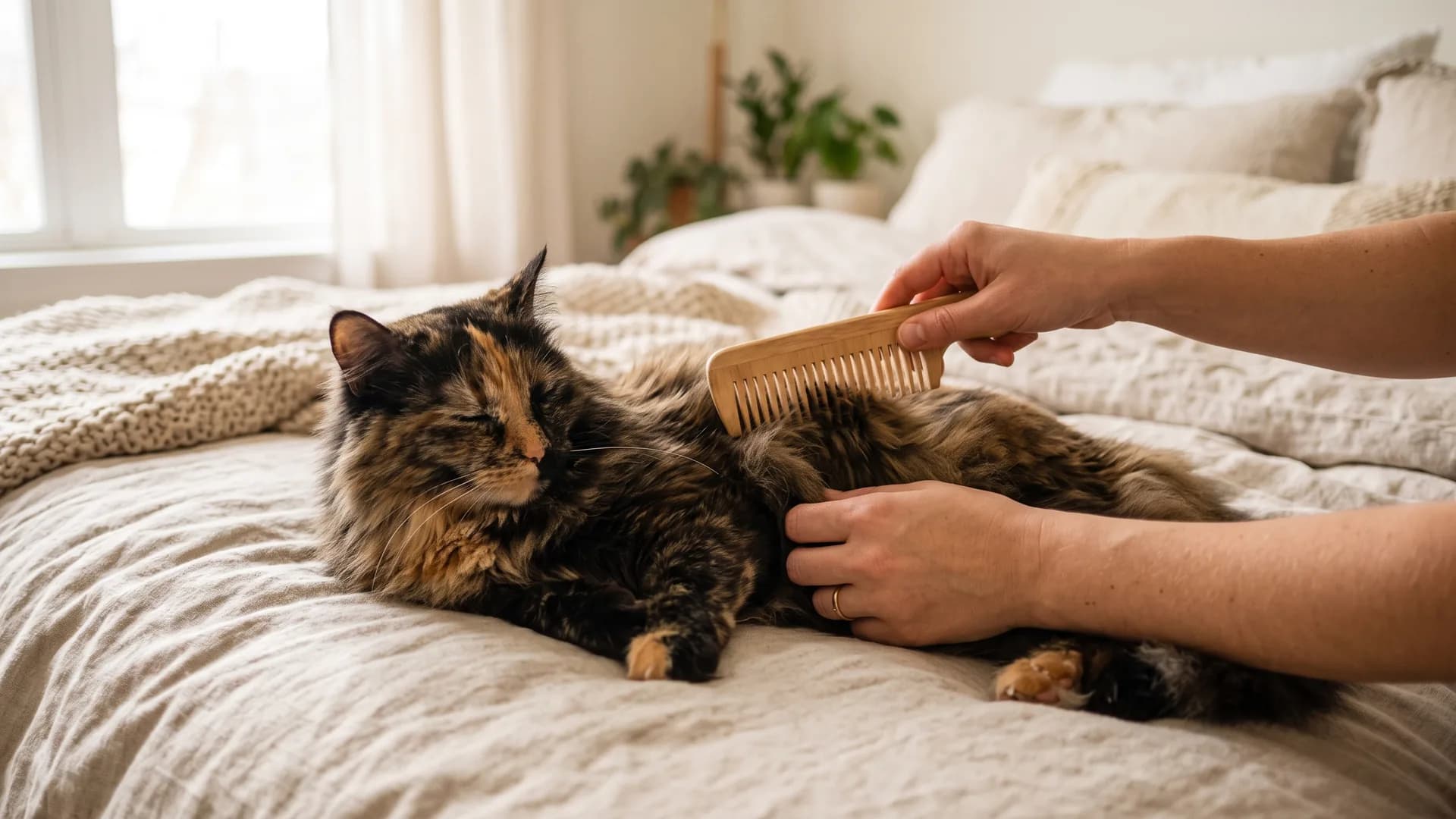
Regular brushing right down to the skin is the whole game — not a stroke over the top, which leaves the forming mat underneath untouched. Line-brush in sections, use the tool the coat actually needs (a slicker and a comb for most, an undercoat rake for a dense shedder), and always brush a coat out before and after it gets wet. A long-haired cat or a heavy double coat needs this several times a week; a quick daily comb through the friction points prevents most of what a groomer otherwise has to cut out.
Working out a small mat
Catch it small and you can save the hair. Work a little detangling spray or even dry cornstarch into the mat, tease it apart with your fingers, then with the end teeth of a comb or a slicker, always from the outer tip inward rather than dragging at the base. The trick that spares the animal pain: hold the hair between the mat and the skin with your other hand, so you are pulling against your fingers and not against the skin. Keep sessions short and stop before patience runs out on either side.
Never bathe or scissor a matted coat
Two common instincts both make it worse. Bathing a matted coat shrinks the knots tighter as they dry, turning a brushable tangle into a solid pad — brush the mats out first, then bathe. And never cut a mat with scissors: a mat sits flush to skin that tents up into the blades, and vets treat the results routinely. If a mat will not comb out, it is clipped off with proper clippers, not cut.
When to hand it over
A coat that has gone past individual mats into a solid pelt, mats too tight or close to the skin to lift a blade under safely, or any sign of trouble underneath — moisture, smell, a sore, an animal that flinches — is a job for a groomer or a vet, sometimes under sedation so it can be shaved without a fight or an injury. That is common and kind, especially for an overweight or elderly cat. Once the coat is back to a clean start, the wash-and-brush routine is what keeps it there.
How do I get a mat out of my dog or cat?
Catch it small: work in detangler or dry cornstarch, tease it apart with your fingers and then the end of a comb, always from the outer tip inward, holding the hair between the mat and the skin so you pull against your fingers rather than the skin. A mat that will not lift is clipped out, never cut.
Can I cut a mat off with scissors?
No — this is one of the more common ways owners end up at the vet. A mat sits flush against skin that tents up into the blades, and the cut goes into the skin rather than the hair. A stubborn mat is shaved off with clippers by a groomer or vet, not cut with scissors.
Why does my cat suddenly have matted fur?
A cat that mats where it used to stay smooth has usually stopped grooming that area — through age, extra weight it can no longer reach around, arthritis or dental pain that makes grooming hurt. The mats appear on the back, rump and behind the legs. It is worth a vet check as much as a groom, since the cause is often physical.
How do I stop my pet's fur matting?
Brush right down to the skin, in sections, several times a week for a long or double coat — a stroke over the top leaves the forming mat underneath. Use the right tool for the coat, brush before and after the coat gets wet, dry it fully, and keep on top of the friction points behind the ears, legs and tail.
Should I bathe a matted dog?
Not until the mats are out. Water shrinks and tightens mats as they dry, turning a tangle you could still brush into a solid pad against the skin. Brush and detangle the coat first, then bathe, then dry it thoroughly while brushing so it does not re-mat.