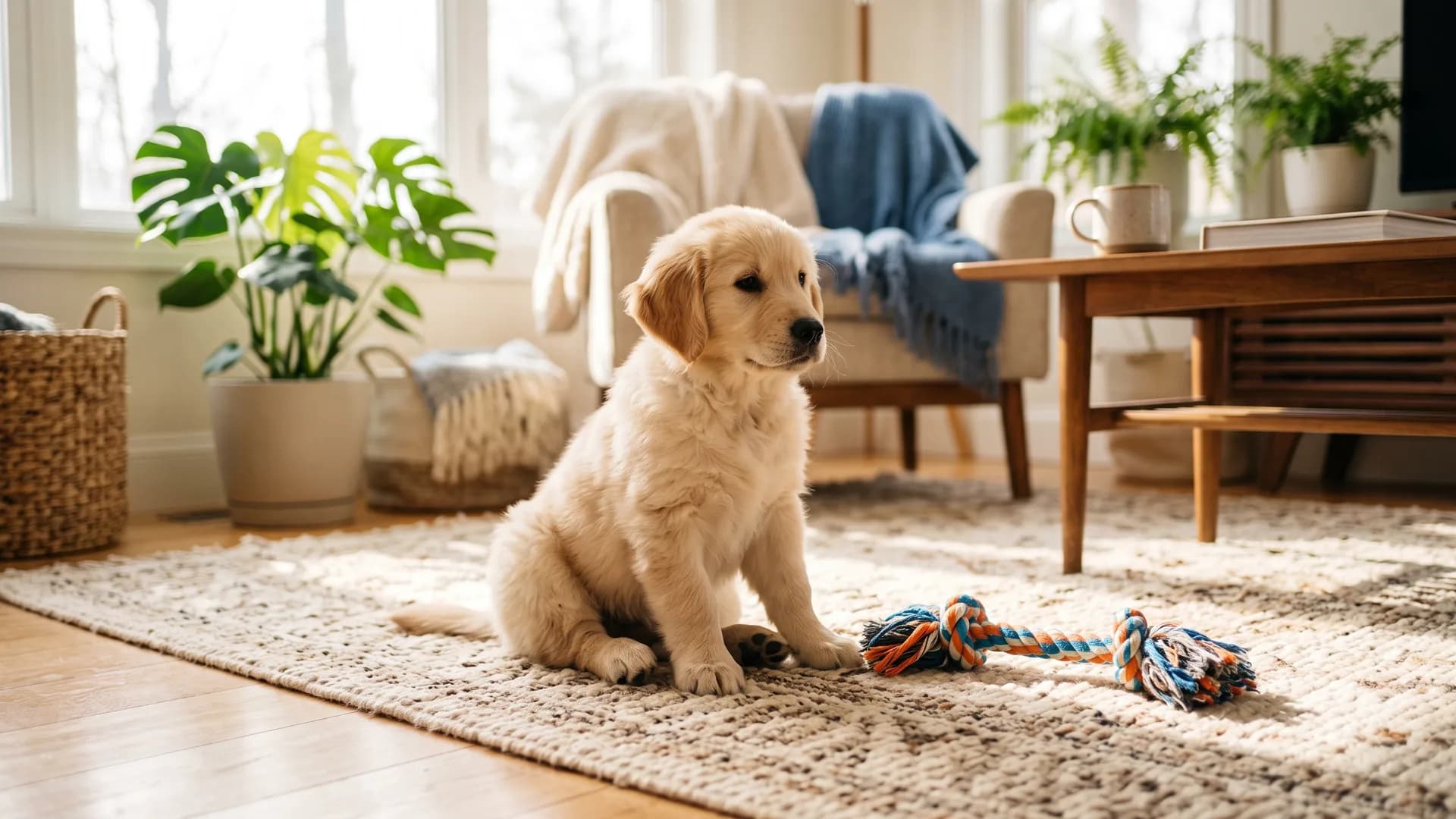
The first week with a new puppy: a calm start
The first week sets the tone. Keep the world small, the routine steady and the expectations low, and you trade a few chaotic days for a puppy that settles faster and trusts you sooner.
The urge in the first week is to do everything — meet everyone, see everywhere, start every lesson. A puppy does better with the opposite. The early days are about safety, sleep and trust, not training milestones, and a small, predictable world is what lets a puppy settle instead of spinning up. Keep it calm now and the rest comes more easily later.
Before it arrives: puppy-proof and set up a base
A puppy explores with its mouth and finds every hazard you missed, so clear the floor of cords, small objects, and the things a home needs made safe before it walks in. Set up a confined base — a pen or a gated area — with a bed, water and a spot for toileting, and introduce a crate as a den rather than a punishment. A small territory is reassuring to a puppy, not restrictive.
The first night
Expect crying — the puppy has just left its mother and littermates. A den close to you, warm and quiet, helps more than banishing it to a distant room. Take it out for a toilet break, then settle it; comfort a distressed puppy without turning frantic barking into a game that gets it out. It is genuinely hard for a few nights and then it passes, which is worth knowing while you are in it. Crate training makes those nights shorter.
Routine from day one
Puppies thrive on predictability: meals at set times, and toilet trips after every sleep, meal and play session, plus first thing and last thing. And sleep — a puppy needs a great deal of it, far more than people expect, and an over-tired puppy turns into a biting, frantic one. If yours is suddenly manic and nippy, the answer is usually a nap, not more play.
Socialisation without overwhelm
Early socialisation matters and the window is short, but week one is gentle, positive exposure — new sounds and surfaces at home, calm handling, one visitor at a time — not a party. Before vaccinations are complete you can still show a puppy the world by carrying it, so it sees traffic, people and other settings safely. The socialisation window is about quality of experience, not quantity.
Go slow on visitors and other pets
Limit the stream of excited guests in the first days, and introduce any resident pets carefully and in short, supervised sessions rather than all at once. Give the puppy quiet time to decompress between events. Put the first vet visit on the list for a health check and a plan for vaccines and preventives — a calm, non-urgent trip that also teaches the puppy the vet is nothing to fear.
Feeding and the beginning of toilet training
Keep the puppy on whatever food it was already eating for the first days, however tempting it is to upgrade — a new home, a new routine and a new diet all at once is what produces an upset stomach in week one. If you want to change the food, do it gradually over a week or so once the puppy has settled. Feed at set times rather than leaving food down; predictable meals make predictable toilet trips, which is the whole basis of house training.
Toilet training in the first week is about opportunity and reward, not correction. Take the puppy out to the same spot after every sleep, meal and play session, and first thing in the morning and last thing at night, then praise or treat the moment it goes in the right place. Accidents are certain and are not defiance — a young puppy simply cannot hold on for long. Clean them with an enzymatic cleaner so no scent-marker is left to draw the puppy back, and never punish an accident, which only teaches the puppy to hide where it goes rather than to hold on.
Handling, a name, and the first gentle lessons
A week in, a puppy is ready for tiny, fun lessons — not a training programme, but a few seconds at a time. Use its name and reward it for looking at you; reward it for coming when you call in a happy voice; mark and treat a sit that happens by chance. Kept short and light, these first games teach the puppy that paying attention to you is worth its while, which is the foundation everything later is built on. End each little session while the puppy still wants more.
Spend some of the week on gentle handling too, because it pays off for years. Touch the paws, look in the ears, lift a lip to see the teeth, all paired with a treat, so that future vet visits and grooming are routine rather than a wrestle. Give the puppy appropriate chew toys and redirect the inevitable mouthing onto them rather than your hands — teething puppies bite because they must chew, not because they are aggressive. And make sure everyone in the household agrees on the rules from day one: a puppy cannot learn that the sofa is sometimes allowed and sometimes not, and consistency is kinder than a moving line.
What do I need before bringing a puppy home?
A confined safe base (pen or gated area), a crate as a den, a bed, food and bowls, a collar and lead, toys, and toileting supplies — and a puppy-proofed floor with cords and hazards cleared. Setting the space up before the puppy arrives is far easier than doing it around one.
How do I get through the first night with a puppy?
Expect crying — it has just left its litter. Keep its den close to you, warm and quiet, give a toilet break, and comfort it without turning barking into a game that earns freedom. It is hard for a few nights and then eases. A crate introduced as a den makes it shorter.
When can my puppy meet other dogs and people?
Start gently at home in week one — one calm visitor at a time, new sounds and surfaces. Before vaccinations are complete you can still socialise safely by carrying the puppy to see the world. Meeting unknown dogs on the ground usually waits until your vet says vaccine cover is in place.
How much should a puppy sleep?
Far more than most people expect — much of the day. An over-tired puppy becomes frantic and bitey, so when yours is suddenly manic the fix is usually a nap, not more activity. Building regular rest into the routine prevents a lot of the first week's chaos.
Should I crate a puppy at night?
A crate used as a den — never as punishment — gives a puppy a safe, contained place to sleep and helps with toilet training, since puppies avoid soiling where they rest. Keep it near you at first so the puppy is not alone, and build up positive associations with it during the day.
When should my new puppy first see a vet?
In the first days, for a health check and to set up the plan for vaccines, parasite prevention and neutering. Keep the visit calm and pair it with treats, so the puppy learns early that the vet is nothing to fear — a first impression that pays off at every visit for the rest of its life.