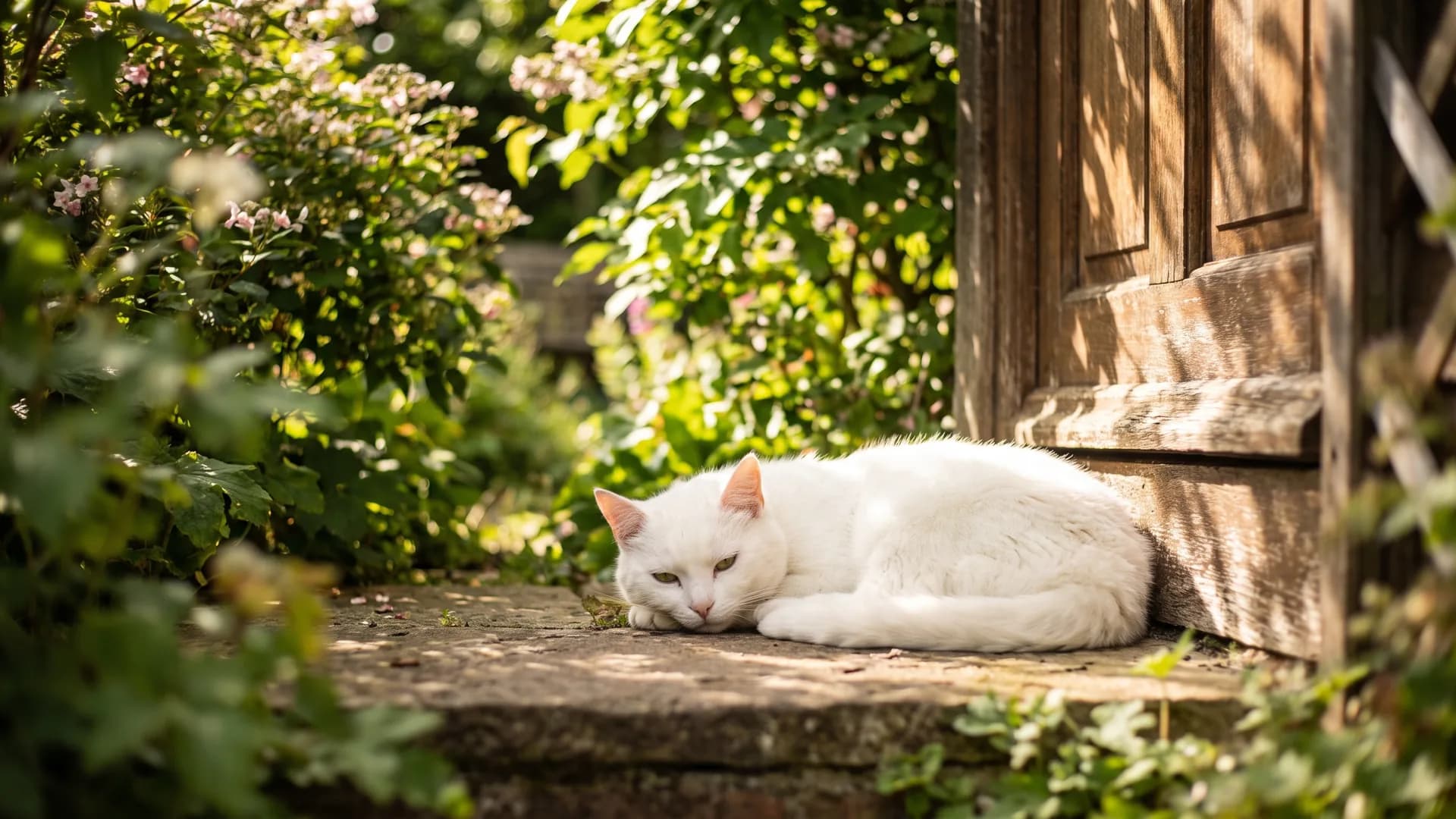
Quiet cat breeds: 25 of 59, and almost nothing in between
The vocalisation ratings split cats into two camps with a near-empty middle — 25 breeds at the quietest rating, 17 at the loudest.
Of the 59 cat breeds rated for vocalisation here, 25 sit at the quietest end and 17 at the loudest.
What's striking is the shape between them: 16 breeds in the middle, and exactly one anywhere near the top without reaching it. The source isn't describing a gradient. It's describing two kinds of cat.
Who is in the quiet camp
The large placid breeds, mostly.
The Ragdoll, Maine coon, British Shorthair, Norwegian Forest Cat and Siberian are all at the bottom of the scale, and so are the Russian Blue, Chartreux and Nebelung.
Quiet doesn't mean silent, and it doesn't mean undemanding. A cat that rarely vocalises still asks for things; it asks by standing somewhere inconvenient instead of by telling you.
Reading down the quiet list, a second pattern shows up alongside the size one: a good many of these are northern breeds, developed in cold places as working or farm cats. Whether that's a real association or an artefact of which breeds got rated is not something this data can settle, and it's the kind of pattern worth noticing without believing too hard.
What cats are actually doing when they talk
It's worth knowing what the rating is rating, because adult cats barely vocalise at each other at all.
Cats hiss and yowl at other cats in conflict, and queens call to kittens — but the conversational meowing that a talkative breed is known for is essentially something cats do at humans. It develops in domestic life, aimed at the one animal in the house that responds to sound rather than to scent and posture.
Which means a talkative cat isn't being loud; it's addressing you. And a quiet cat isn't withholding anything — it's communicating in the ways cats communicate with each other, which are almost entirely visual and chemical and which humans read badly.
That's the useful reframe for anybody choosing on this trait. You aren't picking between a cat that talks and one that doesn't. You're picking between a cat that has learned to use your channel and one that expects you to learn its.
The gap in the middle is the interesting part
A rating scale with almost nothing in its upper-middle is a scale where the rater made a categorical judgement rather than a fine one.
That's a limit worth knowing before you use the number: it can tell you which camp a breed is in, and it can't rank breeds within a camp.
It's the sort of thing worth checking on any rated column anywhere. A scale being used as a scale produces a spread; a scale being used as a label produces clusters at the ends and a hole in the middle. The second kind is still informative — it just answers a coarser question than the numbers imply.
What else the vocalisation column correlates with
Reading the quiet list against the rest of the breed data, a couple of associations show up and both need holding loosely.
Size is the visible one. The quiet camp is heavy with the large placid breeds and the loud camp with the lean oriental types, which is a striking split and not obviously a causal one — a big cat isn't quiet because it's big. More likely both traits were selected together, or inherited together from the same founding populations.
Coat length points the same way, for the same reason: the long-coated northern breeds cluster quiet and the short-coated southeastern ones cluster loud. That's geography showing through two columns at once rather than two independent findings.
What the column doesn't track is temperament in any broader sense. A quiet breed isn't calmer, gentler or lazier in these ratings, and the energy and affection columns don't line up with it. If you're choosing a cat on how much it talks, that's the only question you're answering — everything else is a separate look at a separate column.
What quiet is worth, practically
For some households it's the deciding trait, and it's worth being specific about when that's true.
Thin walls are the clearest case. A cat that yowls at four in the morning is audible to a neighbour in a way that a cat sitting silently on your chest is not, and it's one of the few pet-noise complaints that reaches a flat's management.
Shift work and small children are the other two. A household where somebody is always asleep is a household where a conversational cat is a running negotiation, and it's not a habit that trains away easily — a cat that has learned talking works will keep talking.
Against that, there's a real cost to quiet that people don't anticipate: a silent cat is harder to read when something is wrong. Vocal cats announce a sore mouth, a full bladder or a locked door, and a stoical one simply goes quiet in a different way. If your cat rarely speaks, its changes in behaviour carry more of the signal, and they're easier to miss.
When a quiet cat starts talking
Any marked change in how much a cat vocalises is worth attention, and it runs in both directions.
A cat that becomes noticeably more vocal — particularly loud, insistent night-time yowling in an older cat — is a recognised presentation of several things worth a vet's opinion, among them an overactive thyroid, high blood pressure, pain and cognitive decline. It's one of the more reliable reasons to ring rather than wait.
A cat that goes quiet is harder to notice and matters too. Withdrawal, less greeting, less demanding — those read as a cat mellowing and are also how cats present feeling unwell.
The general rule is the one that runs through every trait on this site: the breed figure describes a population and your cat's own baseline describes your cat. What's worth watching isn't where it sits on a scale but whether it has moved from where it usually sits.
If noise is the deciding factor
It's one of the few breed traits recorded here that genuinely separates the catalogue, which makes it more useful than most.
Compare it with affection, where 54 of the 59 carry the identical top rating and the column tells you nothing at all. The breeds page lets you filter on this one because it actually divides the field.
The caveat is the one attached to every breed rating: it describes a tendency in a population, and individual cats ignore tendencies constantly. A quiet breed produces talkative cats and the reverse, and the surest way to know what you're getting is an adult cat whose voice you've already heard — which is one more argument for adopting a grown animal when a specific trait genuinely matters.
It's also worth remembering that most cats aren't pedigrees at all. The overwhelming majority of household cats have no breed and therefore no rating, and nothing on this page describes them. A moggy is as likely to be silent as to hold a conversation, and the only way to find out is to meet it — which shelters make easy, since staff have generally been listening to the animal for weeks.
The trait ratings on this page are TheCatAPI's, on a one-to-five scale, and they are somebody's assessment rather than a measurement — which is why the dog columns are left empty. Where the breed data comes from.
What is the quietest cat breed?
Twenty-five breeds share the lowest vocalisation rating here rather than one leading it — among them the Ragdoll, Maine coon, British Shorthair, Russian Blue and Siberian.
Why do cats meow at all?
Mostly at us. Adult cats barely vocalise at each other outside conflict, and the conversational meowing a talkative breed is known for developed in domestic life, aimed at the one animal in the house that responds to sound rather than scent and posture.
Are quiet cats less affectionate?
Nothing in this data suggests it. The affection column rates 54 of the 59 rated breeds identically, so it can't support a comparison in either direction.
Are quiet cats calmer or lazier?
Not in these ratings. The vocalisation column doesn't line up with energy or affection, so it answers one question only. It does track size and coat — the quiet camp is heavy with large long-coated northern breeds — but that's probably geography showing through two columns rather than a cause.
Is there a downside to a quiet cat?
One that people don't anticipate: a silent cat is harder to read when something is wrong. A vocal cat announces a sore mouth or a locked door; a stoical one goes quiet in a different way, so its changes in behaviour carry more of the signal and are easier to miss.
My quiet cat has started yowling — should I worry?
Worth a vet call, especially in an older cat at night. A marked increase in vocalisation is a recognised presentation of an overactive thyroid, high blood pressure, pain and cognitive decline. A cat that goes unusually quiet matters too, and is easier to miss.
Can a breed rating predict my cat?
No. It describes what a reference work recorded about the breed. Individual cats vary widely, and a quiet breed can produce a talkative animal — which is an argument for adopting an adult whose voice you've heard if this trait genuinely matters.