Pet names starting with R, the rolling two-beat letter
592 names at 82 registrations each, and 417 of them have exactly two beats. It's the most rhythmic letter in the catalogue.
Rocco. Romeo. Rocky. Roxy. Riley. Remy. Rusty. Say them in a row and you'll hear something the other letters don't have: a rhythm.
417 of this letter is two syllables, one of the highest shares in the catalogue, and the R keeps landing on the stressed one. It's the most musical initial in the alphabet and the most repetitive, which are two descriptions of the same fact.
Used well above average
The letter averages 82 registrations per name, comfortably above the catalogue figure. There's a straightforward physical reason for it: a rolled or tapped opening is easy to say with force and easy to repeat, and this is the letter where the sound and the use line up most obviously.
Try it yourself. Rocky can be said three times in a row at increasing volume without your voice tiring or the word losing its shape. Very few names in the alphabet do that, and the ones that do tend to be popular.
It reads male despite sounding soft
253 of these names measure male against 124 female, which is a wide gap, while 233 of the letter classifies as soft-sounding.
Those two facts sit oddly together and both are true. R is a liquid consonant, so the classifier hears softness in it — there's no stop, no burst, no friction. But the names people have actually built on it are Rocco, Rex, Ranger, Rambo and Rocky. The consonant is gentle; the vocabulary chosen for it is anything but.
That gap is one of the more interesting things in this catalogue, because it shows the limits of classifying names by sound alone. A machine hears Rambo as soft. No human being ever has.
Why R feels tougher than it is
The reason is probably association rather than acoustics. R is the sound of a growl, or near enough, and English is full of words that use it for aggression: roar, rage, rip, rough, wreck. When a letter's most common words all point one way, the names inherit the direction.
It also rolls. In many accents an initial R involves the tongue curling or tapping, which gives the sound a physical texture that a nasal or a fricative doesn't have. You can put force into an R in a way you can't put force into an N, and that's audible even when the word itself is gentle.
A note on the ending
106 of the letter closes on -y or -ie, and this is where the rhythm becomes a liability rather than an asset.
Roxy, Rocky, Rusty, Ruby, Riley, Remy. Six names. Two syllables each. R at the front, lift at the back, stress on the first beat. At fifty metres, in wind, they are one word. If you have two animals and both names are drawn from that group, you don't have two names — you have one name and a coin toss.
It's the single most common naming mistake this letter produces, and it's entirely avoidable: change the vowel after the R, not the ending. Roxy and Rusty share a shape but their vowels are miles apart, which is enough. Roxy and Rocky share both, which isn't.
The accent question
Worth knowing if your household spans accents, because R is the most variable consonant in English. At the end of a word it disappears entirely in most of England, Australia and parts of the eastern United States, and is pronounced firmly almost everywhere else.
At the front of a word, which is what concerns this page, it's pronounced by everybody. That makes R names unusually safe for a mixed-accent household or for an animal that might move countries: Rocco is Rocco in Glasgow, Sydney and Boston alike, where a name ending in R is three different words in those three cities.
Where the R names come from
Rex is Latin for king and is possibly the most archetypal dog name in the English language, to the point where it's used as a placeholder in jokes and cartoons. Rocco is Italian, from a Germanic root meaning rest, which is not how most Roccos behave. Romeo arrives via Shakespeare and goes almost exclusively to affectionate male animals with no sense of personal space.
Rocky is a film, always. Rusty is a colour, and one of the great honest descriptive names for a red-brown animal. Ruby is a stone and also a colour. Riley is an Irish surname that became a given name and then a pet name, following the same road as Harley and Piper.
Naming a litter to R
Supply is not the problem here — the letter is deep and heavily used — but the two-beat trap is worse in R than anywhere else in the alphabet, precisely because the letter's most attractive names all share one rhythm.
Build across the vowels and across the lengths. Rex, Rosie, Rocco, Rue, Ranger, Ripley. One beat, two beats, two beats with a different vowel, a monosyllable with a long vowel, a hard-ending compound and a three-syllable. Six names nobody could confuse, all correctly filed under R.
The R names that aren't two beats
Since the letter's whole character is its rhythm, the names that break it are worth pointing at. Rex, Rue, Roo, Rain, Reed, Ridge and Rook are all one beat, and every one of them sounds noticeably different from the rest of this letter as a result.
They carry differently too. A one-syllable R name puts the roll and the vowel and the closing consonant into a single short package, which arrives at a distance as one solid event rather than a rolling two-part shape. If you want an R name for a dog that ranges a long way, start here rather than with the popular list.
At the other extreme sit the three-beat names — Rosalie, Rhiannon, Roosevelt, Ripley — which are rarer and almost always shortened in use. They're worth choosing only if you like the short form, since the short form is the name.
A note on spelling
R is mercifully simple to write down and hard to get wrong, which is not true of every letter in this alphabet. There's no soft R and no hard R, no silent variant, and no competing spelling that produces the same sound the way C and K do.
The one place people trip is the doubled consonant in the middle. Rocco has two Cs, Rocky has one. Remy is sometimes written Remi, and both are common enough that you'll be asked. If you'd rather never spell a name at a reception desk, the single-consonant R names are the safest bets in the letter.
R names for cats
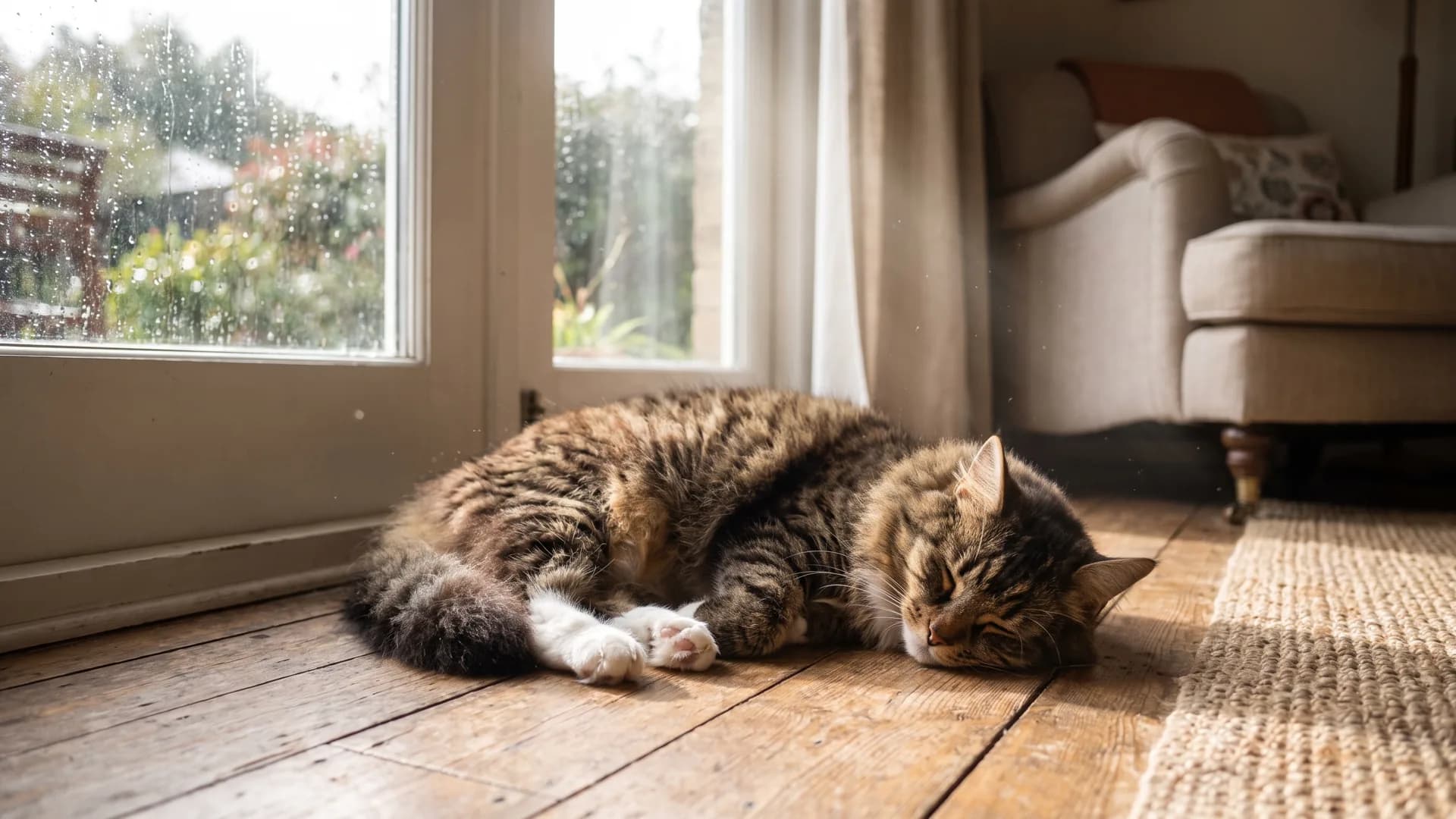
Cats take the softer, rounder end: Rosie, Ruby, Remy, Rory, Rascal. The growl association more or less evaporates on a cat, which is why Rocky on a tabby reads as affectionate where the same name on a bull breed reads as a statement.
Rascal is the pick of the letter for a cat and belongs to the small family of names that describe behaviour rather than appearance — Bandit, Trouble, Mischief. Those names are a gamble taken at eight weeks old that the animal will grow into the accusation, and with cats it's a gamble that pays out with remarkable reliability.
The one thing to watch for indoors is that a rolled R is hard to say softly. It's a name that always arrives with a bit of energy in it, which suits a cat you're playing with and less so a nervous one you're trying to coax out from under a bed.
What are the most popular pet names starting with R?
Riley, Roxy, Rocco, Romeo and Rusty lead the list, ordered by registration count across public register sources.
Why do R names sound punchy?
417 of the letter is two syllables with the R landing on the stressed one, which is a rhythm that repeats easily and takes volume well. The letter is used at 82 registrations per name, above the catalogue rate.
Are R names male?
They lean male at 253 against 124, even though 233 of the letter classifies soft-sounding. The consonant is a liquid with no stop in it; the vocabulary people have built on it — Rex, Ranger, Rambo, Rocco — is not soft at all.
Can I use Rocky and Roxy for two pets?
Not comfortably. They share an initial, a rhythm, a stress pattern and a vowel, which makes them one sound at any real distance. Changing the vowel after the R — Roxy and Rusty, say — gives you the separation that changing the ending doesn't.
What are good R names for a cat?
Rosie, Ruby, Remy, Rory and Rascal. The growl quality that makes R names read as tough on a dog largely disappears on a cat, so the letter's blunter names become playful rather than serious.