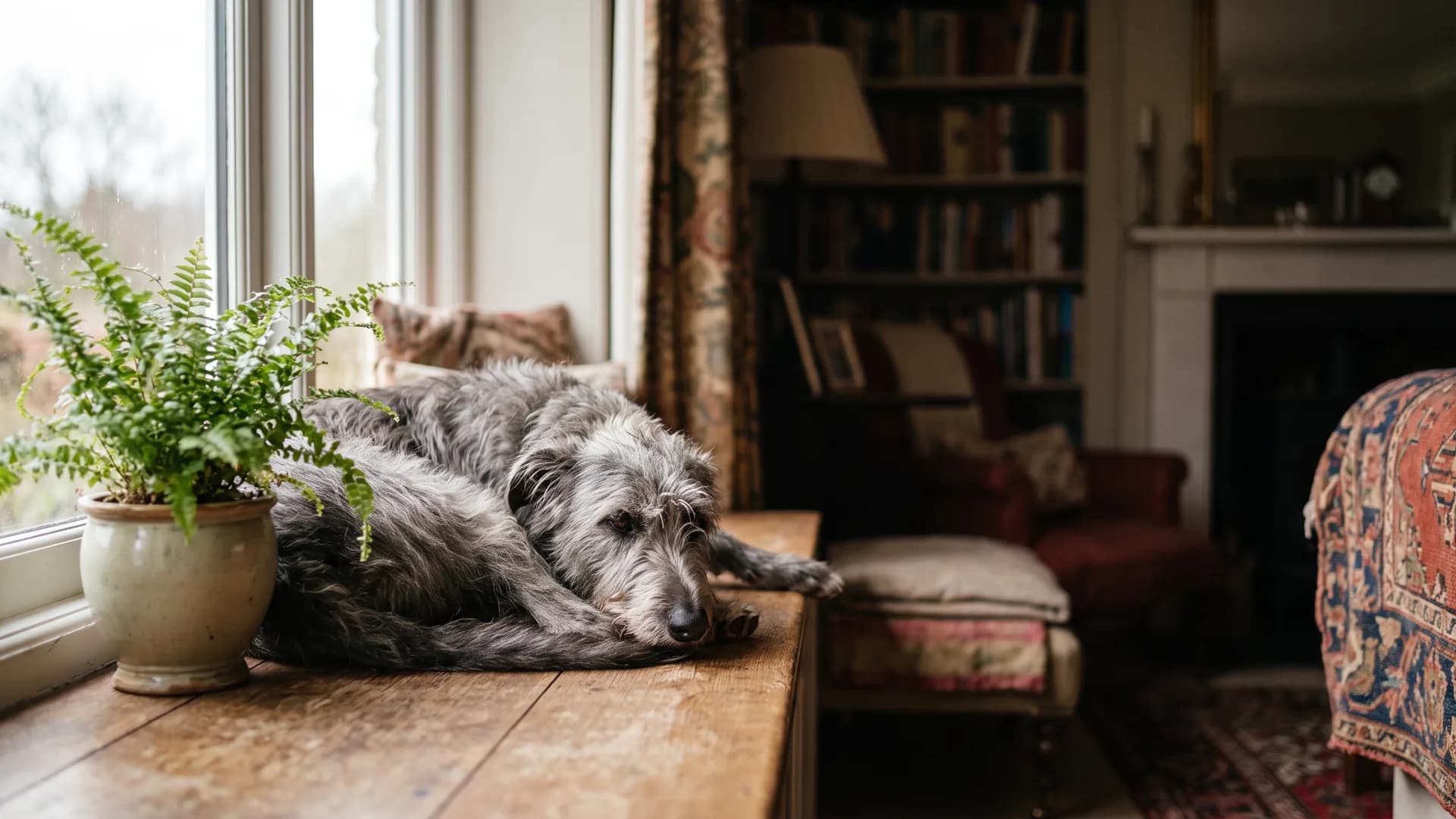
Seul à la maison : apaiser l'anxiété de séparation d'un chien
Un chien qui hurle, détruit ou salit la maison uniquement quand on le laisse ne fait pas de bêtises — il panique. Distinguer cela d'un simple ennui est la première étape, et cela change tout ce qu'on entreprend ensuite.
Rentrer et trouver le chaos se lit facilement comme un chien qui se venge, et l'anxiété de séparation est le diagnostic vers lequel les propriétaires se tournent d'abord.
Parfois il est juste ; souvent la vérité est plus terne et plus facile à régler. Les deux se ressemblent depuis le pas de la porte et appellent des conduites entièrement différentes : le premier travail est donc de les séparer.
Panique ou ennui ? Filmez
Une vraie anxiété de séparation est une détresse liée spécifiquement au fait d'être laissé : va-et-vient, salivation, hurlements, griffades sur les portes, ou élimination malgré la propreté acquise, démarrant d'ordinaire dans les minutes qui suivent la fermeture de la porte.
L'ennui produit du désordre aussi — mâchouillage, grattage, aboiements par intermittence — mais chez un chien qui se pose entre deux et vous accueille normalement.
Un téléphone posé sur une étagère tranche en une absence, et c'est la première demi-heure qui compte. Un chien qui s'ennuie dort au bout de vingt minutes et se réveille pour trouver quelque chose à faire. Un chien anxieux ne se pose pas du tout : le va-et-vient commence avant que vous ayez atteint la voiture et la détresse est continue.
Presque tout ce qui suit dépend de ce que vous avez filmé : autant le faire avant d'acheter ou de changer quoi que ce soit.
Ce que les images montrent d'ordinaire
Deux détails prennent les gens au dépourvu, et tous deux méritent d'être guettés.
Le premier, c'est que les dégâts surviennent souvent dans le premier quart d'heure, puis cessent. Les propriétaires imaginent quatre heures de destruction et découvrent que le chien a passé quinze minutes affolé devant la porte et le reste de l'après-midi couché à côté. C'est utile : cela indique que le problème est le départ et non la durée, ce qui change ce qu'il faut répéter.
Le second, c'est la nourriture intacte. Un jouet garni qui revient exactement comme il est parti est l'un des signaux les plus clairs qui soient, parce qu'un animal effrayé ne mange pas. Si l'on vous a dit que le chien va bien puisqu'il a un joli jouet, le jouet vous dira le contraire.
La détresse commence avant votre départ
L'autre chose que montre la caméra, c'est à quel point cela commence tôt.
Les clés, les chaussures, une veste précise, l'ordinateur qui se referme — un chien anxieux a appris la séquence et il a déjà peur pendant que vous êtes encore dans la maison.
Cela compte en pratique : si vous ne répétez que la sortie par la porte, vous répétez le dernier maillon d'une chaîne que le chien redoute depuis dix minutes.
Détachez donc les signaux du départ. Prenez les clés et asseyez-vous avec. Enfilez vos chaussures et faites du thé. Faites-le assez souvent, au hasard, pour que la séquence cesse d'annoncer quoi que ce soit. C'est fastidieux, et c'est la partie qui bouge l'aiguille le plus tôt.
Allonger le temps d'absence, sous le seuil
L'entraînement lui-même est sans panache. Trouvez la durée pendant laquelle le chien reste détendu — dans un cas sévère, ce peut être la porte fermée trois secondes — et travaillez juste en dessous, car une séance qui fait basculer le chien dans la panique enseigne l'inverse de ce que vous vouliez.
N'allongez que tant que le chien reste calme, variez les durées au lieu de gravir une échelle, et arrêtez pendant que cela se passe encore bien.
Varier compte plus qu'on ne le croit. Un chien qui a droit à dix secondes, puis vingt, puis trente, apprend que chaque absence est plus longue que la précédente, ce qui est en soi une source d'appréhension. Mêler cinq secondes, quarante, puis de nouveau dix enseigne tout autre chose : que la durée est imprévisible et qu'aucune n'est dangereuse.
Gardez les départs et les retours sans drame. Un long adieu et des retrouvailles bruyantes augmentent tous deux l'enjeu de la porte.
Le progrès se mesure en semaines, et il est normal qu'il recule après une semaine éprouvante ; la réponse à une rechute est de redescendre à une absence plus courte, pas de forcer le passage.
Ce qui ne marche pas, même si cela paraît sensé
La punition. Le comportement vient de la peur, et punir un animal effrayé de l'être creuse la peur. Cela arrive en outre longtemps après les faits, si bien que le chien ne peut la relier à rien, sinon à votre retour.
Un deuxième chien. La suggestion la plus fréquente et l'une des moins fiables : un chien en anxiété de séparation vous manque vous, pas la compagnie en général, et quantité de chiens anxieux sont tout aussi en détresse dans une maison pleine de congénères. Cela aide à l'occasion. C'est une expérience très coûteuse à mener sur une supposition.
L'enrichissement seul. Un jouet garni est excellent pour un chien qui s'ennuie et inutile pour un chien qui panique, parce qu'un animal effrayé ne mange pas. Si la nourriture revient intacte, ce n'est pas un jouet raté — c'est votre diagnostic qui se confirme.
Enfermer le chien. Le confinement aggrave souvent la panique au lieu de la contenir, et des chiens se blessent sur des portes de caisse et des cadres de fenêtre en tentant de sortir. Si les dégâts se concentrent aux issues et que le chien a des dents cassées ou des griffes arrachées, cessez de confiner et faites-vous aider.
Ce qui aide vraiment, en marge
Rien de tout cela ne règle le problème et plusieurs de ces mesures rendent l'entraînement plus facile, ce qui est déjà bon à prendre.
Le son aide certains chiens, surtout en appartement, où les bruits d'allées et venues des voisins font partie du déclencheur. Un son continu et texturé — une radio parlée, un ventilateur — couvre mieux le couloir qu'une musique avec des silences.
Une vraie promenade avant de partir vaut mieux qu'une promenade après votre retour, sans se substituer à l'entraînement. Un chien qui a vidé ses pattes et son nez part d'un niveau de base plus bas pour être anxieux.
Et une routine de départ constante, une fois les signaux découplés, donne au chien quelque chose de prévisible. La prévisibilité apaise, même quand ce qui est prévu est une absence.
Ce qui ne marche pas, c'est tout dispositif qui punit le bruit. Un collier anti-aboiement sur un chien qui panique ajoute la douleur à la peur, et le silence qu'il produit n'est pas un chien apaisé.
Gérer le présent pendant l'entraînement
L'entraînement prend des semaines ; le chien doit tout de même traverser cette semaine-ci. La réponse honnête à court terme consiste à réduire la fréquence des moments où il reste seul — un promeneur à midi, une garderie deux jours, un voisin, du télétravail quand c'est possible, ou une famille qui décale ses horaires.
Ce n'est pas de la triche : chaque absence qui se termine en panique défait l'entraînement, et éviter ces absences fait partie du traitement. Combien de temps un chien peut rester seul traite la version ordinaire de la même arithmétique.
Autant être direct sur le coût de l'inaction. Un chien laissé à paniquer quatre heures par jour, cinq jours par semaine, ne s'habitue à rien : il répète, et le problème empire en général au lieu de s'arranger.
Quand faire appel à un professionnel, et à quoi sert un traitement
Une anxiété de séparation sévère est un problème de bien-être et non un défaut qu'on gronderait pour le faire disparaître : autant demander de l'aide tôt plutôt qu'après des mois de dégâts.
Un vétérinaire écarte les causes médicales qui l'imitent — douleur, déclin cognitif chez un chien âgé, problème de propreté d'origine physique — et un comportementaliste qualifié bâtit un plan pour l'animal en particulier.
Le médicament, quand il est employé, n'est ni une sédation ni un substitut à l'entraînement. Il abaisse la panique assez pour que le chien puisse réellement apprendre quelque chose d'une absence courte et calme, ce qu'un chien en pleine fuite ne peut pas. Il accompagne un plan comportemental et il est prescrit par un vétérinaire qui a examiné le chien.
Les gens résistent souvent à cette étape plus longtemps qu'ils ne le devraient, en général parce qu'un traitement leur paraît un aveu. Il n'en est pas un. Un chien qui ne peut pas apprendre parce qu'il est terrifié est un chien dont l'entraînement échouera, si bon que soit le plan.
Le chien adopté, et la lune de miel qui finit
Un schéma à connaître, parce qu'il prend les adoptants au dépourvu et ressemble à une rechute.
Un chien fraîchement adopté supporte souvent la solitude la première semaine ou les deux premières — non parce qu'il est posé, mais parce qu'il est en retrait, absorbant tout et n'offrant que peu. Puis, à mesure qu'il se détend et s'attache, l'anxiété apparaît, et le propriétaire conclut qu'il a fait quelque chose de travers.
Il n'en est rien. Un chien qui montre de la détresse à la troisième semaine est un chien qui a décidé que c'était chez lui et que vous étiez sa personne : c'est un progrès déguisé en désagrément. Commencez le travail à ce moment-là plutôt que d'attendre de voir si cela se retasse tout seul.
Ce que personne ne peut vous promettre
Il n'y a pas de calendrier. Certains chiens s'améliorent nettement en un mois, d'autres mettent un an, et une proportion reste faite de chiens qu'on ne devrait pas laisser seuls longtemps — ce qui est un résultat de gestion et non un échec.
Cela ne s'éduque pas non plus à la fermeté, ne s'use pas en l'ignorant, et ne se règle pas avec un appareil qui effraie le chien jusqu'au silence.
Ce qui aide de façon fiable, c'est la patience, des absences assez courtes pour réussir, et l'intervention d'un professionnel avant que le chien ait passé six mois à avoir peur.
Comment savoir si mon chien souffre d'anxiété de séparation ?
Filmez une absence et regardez les trente premières minutes. L'anxiété ressemble à une détresse liée spécifiquement au départ — va-et-vient, salivation, hurlements, tentatives de fuite ou élimination chez un chien propre — démarrant en quelques minutes. Un chien qui s'ennuie fait du désordre aussi, mais se pose entre deux et vous accueille normalement.
L'anxiété de séparation se guérit-elle ?
Elle s'améliore en général beaucoup, et certains chiens s'en remettent entièrement. La méthode consiste en absences assez courtes pour que le chien reste calme, allongées lentement, avec les signaux de départ répétés séparément. Les cas sévères demandent un comportementaliste et parfois un traitement. La punition aggrave, car le comportement est de la peur et non de la provocation.
Prendre un deuxième chien réglera-t-il l'anxiété de séparation ?
En général non. Un chien en anxiété de séparation regrette sa personne et non la compagnie en général, et beaucoup de chiens anxieux sont tout aussi en détresse avec un congénère présent. Cela aide parfois, mais c'est une expérience coûteuse et irréversible à mener sur une supposition.
Pourquoi mon chien devient-il anxieux avant même mon départ ?
Parce qu'il a appris la séquence — clés, chaussures, ordinateur qui se referme — et que la peur commence là. Répétez ces signaux sans partir : prenez les clés et asseyez-vous, enfilez vos chaussures et restez. Quand les signaux cessent d'annoncer une absence, le chien l'aborde plus calmement.
Faut-il mettre en caisse un chien en anxiété de séparation ?
En général non. Le confinement tend à intensifier la panique plutôt qu'à la contenir, et des chiens se blessent en tentant de forcer caisses et portes. Des dégâts concentrés aux issues, des dents cassées ou des griffes arrachées sont autant de signes qu'il faut cesser de confiner et se faire aider.
Un traitement aide-t-il contre l'anxiété de séparation ?
Il le peut, dans le cadre d'un plan et non à sa place. Ce n'est pas une sédation : il abaisse la panique assez pour qu'un chien puisse apprendre quelque chose d'une absence courte et calme, ce qu'un chien en pleine fuite ne peut pas. Il est prescrit par un vétérinaire qui a examiné l'animal, en parallèle du travail comportemental.
Combien de temps faut-il pour régler une anxiété de séparation ?
Il n'y a pas de calendrier fiable — certains chiens s'améliorent nettement en un mois, d'autres mettent bien plus, et certains restent des chiens qu'on ne doit pas laisser longtemps. Les rechutes après une semaine éprouvante sont normales, et la réponse est une absence plus courte, pas de forcer.
Mon chien adopté supportait la solitude et ne la supporte plus. Que s'est-il passé ?
Il s'est attaché à vous. Beaucoup de chiens fraîchement adoptés tiennent quinze jours parce qu'ils sont en retrait plutôt que posés, et l'anxiété apparaît à mesure qu'ils se détendent et créent le lien. C'est un progrès sous une forme désagréable, et c'est le moment de commencer le travail plutôt que d'attendre.
Faut-il varier la durée des absences pendant l'entraînement ?
Oui, et cela compte plus qu'on ne le croit. Une échelle d'absences toujours plus longues enseigne au chien que chacune sera pire que la précédente. Mêler cinq secondes, quarante, puis de nouveau dix enseigne que la durée est imprévisible et qu'aucune n'est dangereuse.