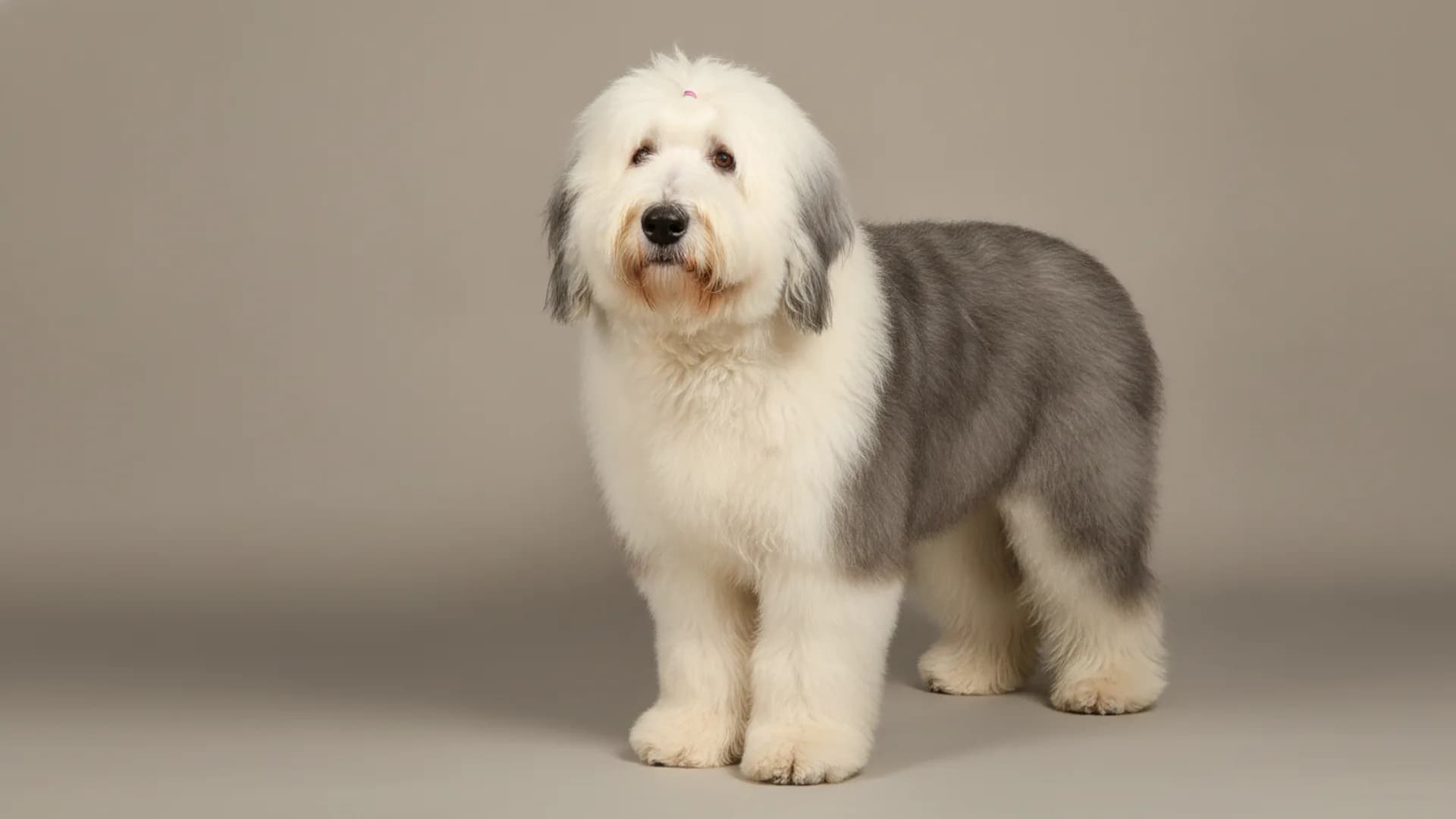
Old English Sheepdog
The Old English Sheepdog is the shaggy grey drover's dog of south-west England, and the tail it was traditionally docked for is the reason it was called a bobtail.
History
Despite the name, both its age and its standing as a sheepdog are open to question. A bob-tailed drover's dog was noticed in the south-western counties of England in the early nineteenth century, and the breed is thought to have grown from that type. One explanation for the docking is tax: drovers' dogs were exempt, and a docked tail marked them out — the origin of the nickname. Its ancestry is unrecorded; the Bearded Collie and Continental sheepdogs such as the Ovcharka are the usual guesses.
It was first shown in Birmingham in 1873, and the American Kennel Club recognised it in 1888. In Britain it is inseparable from the paint advertisements that have featured it since 1961, and many people know it only as the Dulux dog. Fame has not kept its numbers up, and the Kennel Club now lists it as a vulnerable native breed.
Temperament
Underneath the coat is a strong, square, good-humoured dog with a sense of comedy. It is sociable with nearly everyone, devoted to its household and happiest in the middle of it. The standard describes a bold, faithful and trustworthy animal, and aggression or nervousness is out of character.
With children it is patient and playful, though heavy and bouncy enough when young to send a small child flying. It often herds by bumping, using its shoulder to steer people where it thinks they should go. Adolescence is boisterous and can be stubborn, and the breed keeps a puppyish streak for years.
Living with the breed
An owner lives with the coat first and the dog second. It gathers mud, leaves, snow and burrs outdoors, the beard soaks up water and food and wipes them on the nearest knee. It sheds less onto the carpet than a short-coated dog because dead hair stays caught in the coat, which is exactly why it mats.
The bark is loud and has a tone all its own, a quality the standard actually mentions. The dog moves at a rolling, bear-like amble. It wants company and frets if shut away from the family, and it suffers in hot weather. A house with a garden and an outside tap is the realistic minimum.
Care and training
Budget several hours of grooming a week for a full coat, spread over daily sessions. The hair must be parted and brushed in layers from the skin outwards, since brushing the surface leaves felt underneath. Many pet owners have the dog clipped short several times a year, which is sensible and does it no harm. Puppies should be taught to lie still on a table for brushing well before the adult coat comes in.
Exercise needs are high: the Kennel Club suggests more than two hours a day of walking and free play. The breed is intelligent and trainable but has a mind of its own, so short, cheerful sessions work better than repetition. Teach it early not to jump up or lean on people.
Health
Hip dysplasia, a faulty formation of the hip joint leading to arthritis, is the main orthopaedic concern and is scored by X-ray, as are the elbows. Breeding stock also has its eyes examined. The breed carries a raised risk of bloat, in which the stomach fills with gas and twists, and is predisposed to allergic skin disease.
Dilated cardiomyopathy, a weakening and enlargement of the heart muscle, is reported. A DNA test is available for primary ciliary dyskinesia, a defect of the tiny hairs that clear the airways, and the Kennel Club asks breeders to use it. The MDR1 mutation, which makes ivermectin and some related wormers toxic to affected dogs, also occurs in the breed.
Who it suits
It rewards people who are at home, enjoy grooming or will pay a groomer regularly, and want a large, companionable clown. It is the wrong dog for the house-proud, for hot climates without shade and cool floors, and for anyone who liked the look in a photograph and has not yet held a brush.
Questions
Can an Old English Sheepdog see through its hair?
Not very well when the fringe is left long. The hair over the eyes is part of the traditional look, but many owners tie it up or trim it so the dog can see clearly, and doing so causes no harm. The eyes underneath may be dark, blue, or one of each.
How much grooming does an Old English Sheepdog need?
A great deal: several hours a week for a full coat, worked through to the skin, plus daily tidying of the beard and feet. Left for even a week or two it mats into a solid pelt. Keeping the dog in a short clip cuts the work drastically and is what most pet owners choose.
Do Old English Sheepdogs have tails?
Most are born with them, though a few are natural bobtails. The "bobtail" was otherwise produced by docking puppies, a practice no longer allowed in Britain and many other countries, so dogs there carry a long, well-feathered tail. The American standard still calls for a docked tail.
Why is it called the Dulux dog?
Because the paint brand Dulux has used an Old English Sheepdog as its mascot since an advertising campaign in 1961. The association has lasted so long that the brand name became a common nickname for the breed.
Are Old English Sheepdogs good with children?
Yes, they are affectionate, tolerant and fond of play. The reservations are physical: a young dog is big and clumsy and may knock a child down or nudge it about in an attempt to herd.
Characteristics
- Origin
- England
- Size
- Giant
- Weight
- 27–45 kg
- Height
- 53–61 cm
- Lifespan
- 10–12 yr
- Group
- Herding
Traits
- Affection
- Energy
- Intelligence
- Shedding
- Grooming
- Good with kids
Similar breeds
Dogs with a comparable size, coat and temperament.
| Breeds | Size | Weight | Height | Lifespan | Coat |
|---|---|---|---|---|---|
| Old English Sheepdog | Giant | 27–45 kg | 53–61 cm | 10–12 yr | — |
| Bouvier des Flandres | Giant | 35–55 kg | 62–68 cm | 10–12 yr | — |
| Calupoh | Giant | 27–45 kg | 56–75 cm | 12–14 yr | — |
| Kuvasz | Giant | 32–52 kg | 66–76 cm | 10–12 yr | — |
| Carpathian Shepherd Dog | Giant | 32–45 kg | 65–73 cm | 12–14 yr | Long |